
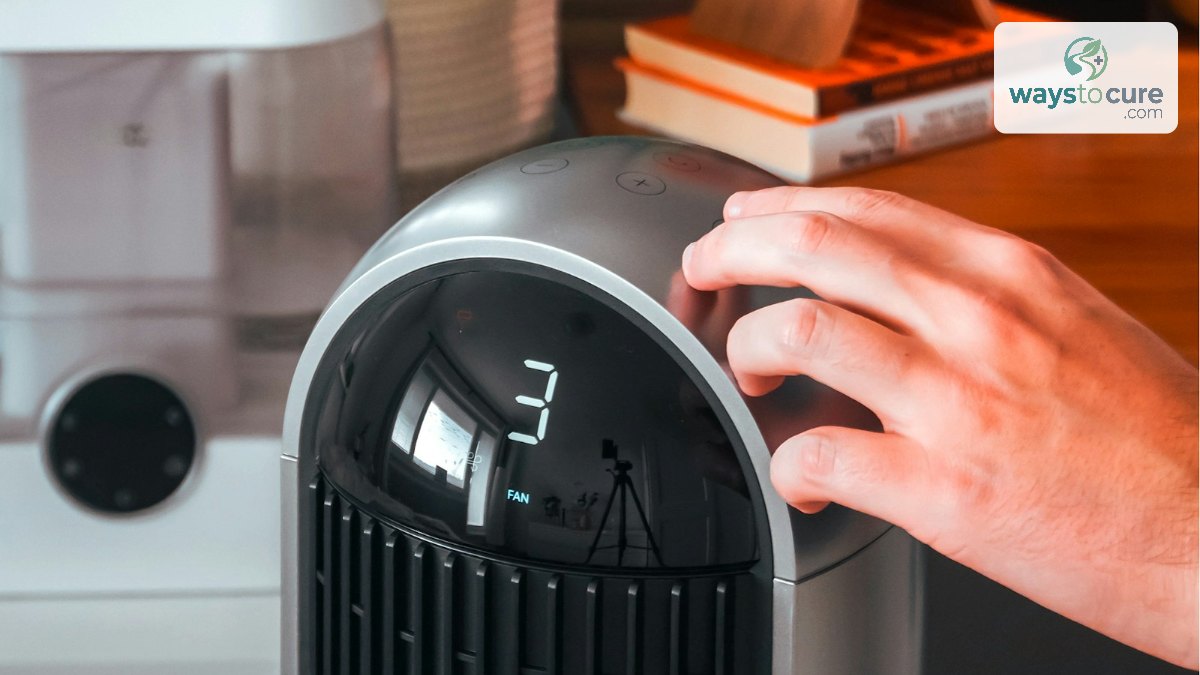
Buy a purifier with a true HEPA filter and a smoke CADR (clean air delivery rate) of at least two-thirds of your room’s floor area in square feet, make sure it doesn’t produce ozone, and run it all the time in the room you use most. Those three numbers and one warning label matter far more than app control, colour-changing lights or a long list of “layers”.
Here’s how to read the box, size the machine to your room, compare filters, work out running costs and set realistic expectations.
What CADR means and how to read it
CADR tells you how much filtered air a purifier delivers. The US Environmental Protection Agency puts it simply: the higher the CADR, the more particles the air cleaner will remove and the larger the area it can serve.
A few things trip people up on Indian boxes:
- Units differ. US-style ratings are in cubic feet per minute (cfm). Many models sold in India quote m³/h. To convert, 1 cfm is about 1.7 m³/h, so 200 cfm is roughly 340 m³/h.
- Several CADRs. If the spec sheet lists more than one figure, use the smoke CADR. EPA’s sizing advice for smoky, polluted air is based on that number.
- “Coverage area” without a CADR. Treat this with caution. Without a CADR you can’t check how the area was worked out.
Matching a purifier to your room size
EPA’s rule of thumb is to choose a purifier with a smoke CADR of at least two-thirds of the room area in square feet. Measure the length and width of the room, multiply them, and take two-thirds.
| Room floor area | Typical Indian room | Minimum smoke CADR (cfm) | Approx. in m³/h |
|---|---|---|---|
| 100 sq ft | 10 x 10 ft small bedroom or study | 67 | 114 |
| 120 sq ft | 10 x 12 ft bedroom | 80 | 136 |
| 150 sq ft | 12 x 12.5 ft bedroom | 100 | 170 |
| 200 sq ft | Master bedroom | 133 | 227 |
| 300 sq ft | Living-dining area | 200 | 340 |
These figures assume an 8-foot ceiling, which is what EPA’s CADR charts are based on. Many Indian flats have 9 to 10-foot ceilings, and older bungalows go higher. EPA says that with ceilings above 8 feet, you should pick a unit sized for a larger area. If you’re between two models, go up a size. A bigger machine on a lower fan speed is also quieter than a small one on full blast.
Air changes per hour: a second check
Air changes per hour (ACH) tells you how many times the purifier can, in theory, clean the full volume of air in the room each hour. CDC’s ventilation guidance treats 5 or more air changes per hour of clean air as a rough goal for indoor spaces, and it counts filtered air from cleaners toward that number.
The sum is easy:
ACH = CADR in cfm x 60 ÷ room volume in cubic feet
For a 10 x 12 ft bedroom with an 8 ft ceiling, the volume is 960 cubic feet. A purifier with a smoke CADR of 80 cfm gives 80 x 60 ÷ 960 = 5 air changes an hour. Same room with a 10 ft ceiling (1,200 cubic feet) drops that to 4, which is why taller rooms need a bigger machine. ACH is a planning tool, not a guarantee: doors opening, gaps in windows and people cooking all change the real result.
True HEPA vs “HEPA-type” filters
EPA says a HEPA filter can theoretically remove at least 99.97% of airborne particles 0.3 microns in size. That size is the hardest to catch, so larger and smaller particles are trapped even more efficiently.
Labels you’ll see on the shelf:
- True HEPA, or 99.97% at 0.3 microns: the claim you want, backed by a stated efficiency.
- H13 or H14: grades from the European filter standard EN 1822. In that scheme, an H13 filter has a minimum efficiency of 99.95% at its most penetrating particle size, and H14 is stricter (table of EN 1822 classes). Either is fine for home use.
- “HEPA-type”, “HEPA-like”, “HEPA-style” or “99% HEPA”: these aren’t defined grades. If the maker doesn’t give an efficiency figure and particle size, assume it isn’t true HEPA.
The filter only works on air that goes through it. A good filter in a weak fan still gives a low CADR, which is why CADR is the number to compare first.
Activated carbon: what it does for gases and smells
HEPA traps particles but not gases. For odours, cooking smells and some gaseous pollutants, EPA says to choose a purifier with an activated carbon filter, and adds that carbon filters can be effective provided that there is a large amount of material used in the filter. A thin sheet of black-coated mesh won’t do much. A heavy carbon layer or a separate carbon cartridge is a better sign.
EPA also notes that research hasn’t shown plasma, photocatalytic oxidation or UV light can remove gases effectively in home portable units, so don’t pay extra for those claims alone.
Ozone generators and ionizers: what to avoid
Some “air purifiers” work by making ozone, a lung irritant. EPA advises avoiding air cleaners that intentionally produce ozone and points out that no US federal agency has approved ozone generators for occupied spaces. It also lists ionizers, electrostatic precipitators, plasma units and UV lamps without proper coatings as devices that may emit ozone.
The California Air Resources Board, which tests and certifies air cleaners for ozone emissions, warns that ozone can cause respiratory tract irritation and inflammation and serious breathing difficulty, including asthma. That’s the opposite of what you want for anyone with asthma or COPD in the house. If you or a family member has asthma, stick to a plain mechanical HEPA filter.
Quick checks before buying:
- Words like “ozone”, “activated oxygen”, “ion generator” or “plasma” in the features list: ask if it emits ozone and if that feature can be switched off.
- A CARB certification label (“Meets California ozone emissions limit”) is a good sign if the model has one.
- If the seller can’t answer clearly, choose another model.
Filter replacement and running costs
EPA’s advice is short: all filters need regular replacement, a dirty overloaded filter won’t work well, and you should replace filters according to the manufacturer’s recommendation. During weeks of heavy smog, expect the filter to clog sooner than it would in cleaner months.
Before you buy, check:
- Replacement filter price and availability. Some cheap purifiers have expensive or hard-to-find filters. Look up the exact part number at an authorised seller.
- Recommended filter life in hours or months, and whether there’s a filter indicator.
- Power use. Find the wattage on the spec label. Daily units of electricity = watts x hours ÷ 1,000. A 50 W purifier running 24 hours uses 1.2 units a day, about 36 units a month. Multiply by your tariff to get the cost.
- Noise. EPA suggests looking for models with low noise ratings, since you’ll be running it for long stretches, including at night.
Where to put it and how to run it
- Room: the one you spend most time in. For most families that’s the bedroom, since you spend the whole night there.
- Position: keep it away from curtains and furniture that block airflow. Don’t jam it into a corner.
- Doors and windows: keep them closed while it’s running during bad-air days, or the purifier is trying to clean the whole neighbourhood.
- Settings: EPA’s smoke advice is to run it continuously on the highest fan setting you can tolerate. Auto mode with a decent particle sensor is a reasonable compromise at night.
What an air purifier can’t do
EPA is blunt about this: no air cleaner or filter will eliminate all the pollutants in your home, and filtration doesn’t replace controlling pollution sources and ventilating. In practice:
- It can’t keep up if windows are open to heavy smog or someone is smoking indoors.
- It does little for dust that has already settled on floors and furniture. Wiping with a damp cloth and mopping help with that; our guide on protecting your lungs at home when the AQI is above 300 has a simple cleaning routine.
- It doesn’t fix the cause of mould or damp smells.
- It doesn’t treat asthma, allergies or sinus problems. It lowers one trigger.
When to see a doctor
Cleaner indoor air should make symptoms easier, not disappear overnight. See a doctor if:
- You or your child still cough, wheeze or wake at night breathless despite cleaner indoor air
- A cough lingers for weeks or keeps coming back (our guide on cough causes and remedies covers the common ones)
- Someone in the house is using a reliever inhaler more often than usual
- You get chest tightness, headaches or eye irritation that’s only worse at home, which may point to an indoor source
Call 112 for severe breathlessness, inability to speak in full sentences, blue or grey lips, or chest pain.
Frequently asked questions
Should I run an air purifier 24 hours a day?
During bad-air days, yes. EPA’s advice for smoky periods is to run it continuously. Outdoor air keeps leaking in through gaps, so levels rise again once it’s switched off.
Can one purifier clean my whole flat?
Usually not. Purifiers clean the room they’re in, with the door closed. It’s better to properly cover one or two rooms you use most than to under-serve the whole home.
Are ionizer purifiers safe?
Some ionizers and similar electronic cleaners can produce ozone, which irritates the lungs. EPA advises against air cleaners that intentionally produce ozone. If you’re not sure about a model, choose a plain HEPA unit instead.
How do I know when to change the filter?
Follow the maker’s schedule or the filter indicator, and change it sooner if airflow drops, the unit gets noisy or the filter looks grey and clogged. During heavy smog, it fills faster than usual.
Is a bigger CADR always better?
Up to a point. A bigger CADR lets you run the machine on a lower, quieter speed and still clean the room.
This article is for general information and is not a substitute for advice from a doctor. If you have symptoms or a health condition, please consult a qualified healthcare professional.