
You can lower LDL (“bad”) cholesterol with food and lifestyle changes: swapping saturated fat for unsaturated fat, adding soluble fibre such as oats and isabgol, eating nuts, moving more and stopping smoking. Together these can make a real difference, but if your doctor has prescribed a statin because your heart risk is high, these changes work alongside the tablet, not instead of it.
Below is what each change can realistically do, what doesn’t work, and when medicine is the right call.
What your lipid report actually means
A lipid profile usually shows four main numbers:
- LDL cholesterol carries cholesterol into artery walls, where it builds plaque. This is the main number to bring down.
- HDL cholesterol helps carry cholesterol away. The NHS treats above 1.0 mmol/L (about 39 mg/dL) for men and 1.2 mmol/L (about 46 mg/dL) for women as healthy.
- Triglycerides are a type of fat that rises with excess sugar, refined carbs, alcohol and extra weight.
- Total and non-HDL cholesterol sum up the rest. Non-HDL is total minus HDL.
Your target LDL depends on your overall heart risk as well as the number itself. The Cardiological Society of India’s 2023 dyslipidaemia guidelines use these targets:
| Your risk category (set by your doctor) | LDL target |
|---|---|
| Low | Below 100 mg/dL |
| Moderate | Below 100 mg/dL |
| High | Below 70 mg/dL |
| Very high | Below 55 mg/dL |
Your doctor places you in a category after looking at your age, blood pressure, blood sugar, smoking, kidney function and family history. Don’t self-assign: two people with the same LDL can need very different treatment.
Swap saturated fat for unsaturated fat
This is the biggest food change for most people. The NHS advises cutting down on fatty meat, butter, ghee, lard, cream, cheese, cakes and biscuits, and food made with coconut oil or palm oil, all of which are high in saturated fat.
In their place, use oils high in unsaturated fat. The NHS names olive and rapeseed oil; in an Indian kitchen, that means using a measured amount of a vegetable oil for cooking rather than generous ghee or vanaspati, and choosing baked or roasted snacks over deep-fried namkeen and mithai. You don’t have to give up ghee entirely, but it shouldn’t be your main cooking fat if your LDL is high.
Add soluble fibre: oats and isabgol
Soluble fibre forms a gel in the gut that traps some cholesterol-rich bile so your body clears more of it. Two foods have good trial evidence:
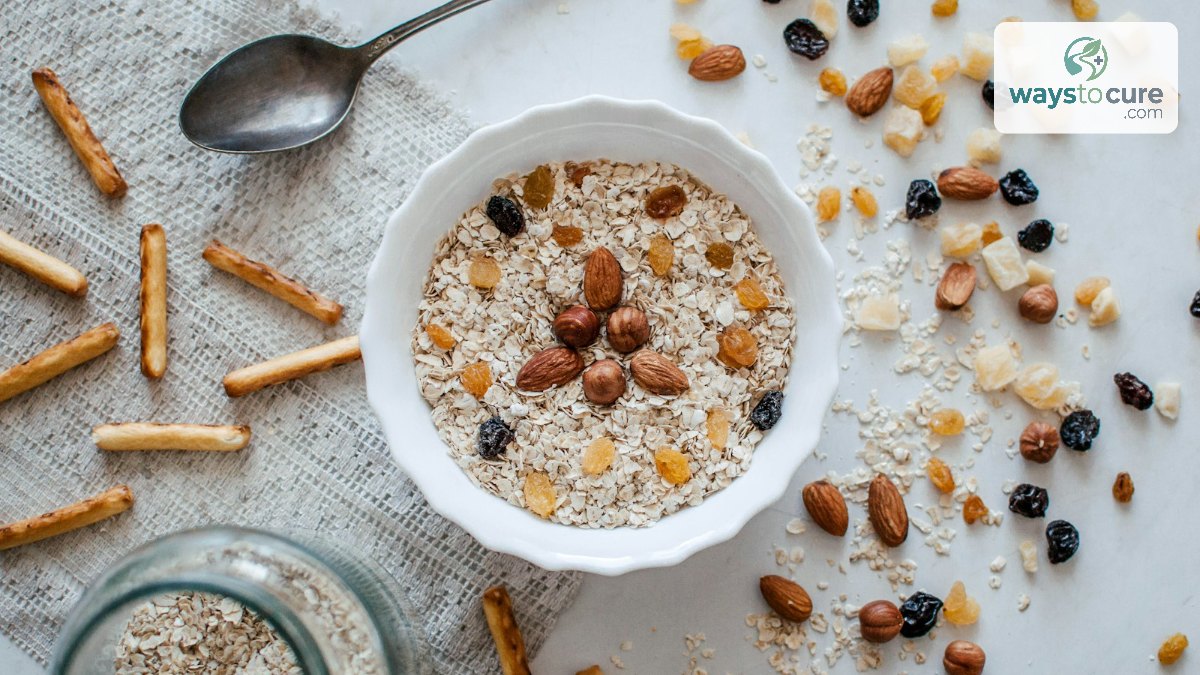
- Oats. A meta-analysis of 28 trials found that at least 3 g a day of oat beta-glucan (the soluble fibre in oats) lowered LDL by about 0.25 mmol/L, roughly 10 mg/dL. It didn’t change HDL or triglycerides.
- Psyllium husk (isabgol). A 2018 meta-analysis of 28 trials, with a typical dose of about 10 g a day, found LDL fell by about 0.33 mmol/L, around 13 mg/dL.
Limits: start with a small amount and build up over a week or two to avoid bloating, and always take isabgol with a full glass of water. If you take other medicines, ask your pharmacist whether to space them away from the fibre. People with swallowing difficulty or a history of bowel narrowing should check with a doctor before using psyllium.
Other soluble fibre sources (rajma, chana, other dals, barley, fruit and vegetables) help too, and fit easily into Indian meals. Our guide to good and bad carbs has more ideas.
Nuts, plant sterols and oily fish
Nuts and seeds are on the NHS list of foods to eat more of. A small handful of unsalted almonds, walnuts or peanuts can replace a fried snack. See our post on soaked almonds if that’s your habit.
Plant sterols and stanols are added to some spreads, yogurts and drinks. A European Atherosclerosis Society consensus found that 2 g a day lowers LDL by about 8 to 10%, and the effect adds to a statin. These products are not easy to find in every Indian town and cost more, so treat them as optional.
Oily fish such as mackerel (bangda), sardines (mathi) and salmon is recommended by the NHS as part of a heart-friendly diet. Vegetarians can lean on nuts, seeds and plant oils instead.
Exercise, weight, alcohol and smoking
- Exercise: aim for 150 minutes of moderate activity a week (a brisk 30-minute walk on five days) or 75 minutes of vigorous activity, as the NHS recommends. Even a short walk after meals is a good start.
- Weight: losing extra weight, especially around the waist, tends to bring triglycerides down and helps LDL.
- Alcohol: the NHS advises not regularly drinking more than 14 units a week, spread over three or more days, with several drink-free days. Less is better, especially if your triglycerides are high.
- Smoking: smoking raises cholesterol and damages artery walls. Quitting is one of the most effective things you can do for your heart.
What doesn’t work (or isn’t proven)
- Garlic pills. The US National Center for Complementary and Integrative Health says garlic supplements may lower total and LDL cholesterol only “to a small extent”. They can also increase bleeding risk, so tell your doctor if you take them, especially if you’re on aspirin or a blood thinner or are due for surgery. Garlic in your cooking is fine.
- “Detox” drinks and cleanses. Your liver and kidneys already handle waste, and there’s no good evidence that detox teas or juices lower cholesterol. Read what the evidence says about herbal detoxes.
- Stopping a prescribed statin in favour of home remedies. In the trials above, oats or isabgol lowered LDL by roughly 10 to 13 mg/dL. That helps, but it won’t replace a medicine your doctor prescribed because your overall risk is high.
When you need medicine: statins and familial hypercholesterolaemia
According to the NHS, statins are offered to people who already have heart or blood vessel disease, or whose risk is high, for example because of diabetes or kidney disease, especially when lifestyle changes haven’t helped or are unlikely to be enough. Statins are usually long-term. Common side effects include headache, feeling sick and muscle aches. Don’t stop on your own; tell your doctor, who can change the dose or switch you to another statin.
Some people have very high cholesterol because of a gene they inherited. This is familial hypercholesterolaemia (FH). MedlinePlus Genetics estimates it affects about 1 in 200 to 1 in 250 people. Clues include a parent, sibling or child with very high cholesterol or a heart attack at a young age, yellowish lumps on the tendons of the hands or the back of the heels, yellow patches on the eyelids, or a grey ring at the edge of the cornea. Diet alone can’t fix FH. It needs medicine, and close relatives should get tested.
How often should you get your cholesterol checked?
The Cardiological Society of India recommends that everyone has a lipid profile by the age of 18, and that lipoprotein(a) is measured at least once in a lifetime. After that, the US CDC suggests most healthy adults get tested every 4 to 6 years, and more often if you have heart disease, diabetes or a family history of high cholesterol.
If you’ve made diet changes, ask your doctor when to repeat the test to see how much they’ve helped. Ask your lab whether you need to fast. Some ask for 8 to 12 hours without food, though many labs now accept a non-fasting sample.
When to see a doctor
Book an appointment if:
- your LDL is very high on a report, or a close relative had very high cholesterol or a heart attack or stroke at a young age (possible FH)
- you have diabetes, high blood pressure or kidney disease and haven’t had a lipid test recently
- you’re on a statin and get muscle pain or weakness you can’t explain
- you notice yellow lumps on your tendons or eyelids
Call 112 immediately for chest pain or pressure lasting more than a few minutes, pain spreading to the arm, jaw or back, sudden breathlessness, fainting, or sudden weakness or numbness on one side of the face or body. If you can’t tell if chest pain is serious, see how to tell gas from a heart attack, but get checked rather than waiting.
Frequently asked questions
How fast can diet lower cholesterol?
Fairly quickly. In the oat trials, the LDL drop showed up in studies lasting anywhere from 2 to 12 weeks. Your doctor will tell you when a repeat test makes sense.
Can I stop my statin once my cholesterol is normal?
Usually not. Your numbers are normal because the statin is working. Stopping it typically lets LDL rise again. Discuss any change with your doctor.
Is ghee bad for cholesterol?
Ghee is high in saturated fat, which raises LDL. A little is fine for most people, but don’t use it as your main cooking fat if your LDL is high.
Is coconut oil good for cholesterol?
No. Coconut oil is high in saturated fat, and the NHS lists food made with coconut or palm oil among things to cut down on if your cholesterol is high.
Does thin or young mean my cholesterol is fine?
No. FH and other causes affect slim, young people too. The only way to know is a blood test.
This article is for general information and is not a substitute for advice from a doctor. If you have symptoms or a health condition, please consult a qualified healthcare professional.