
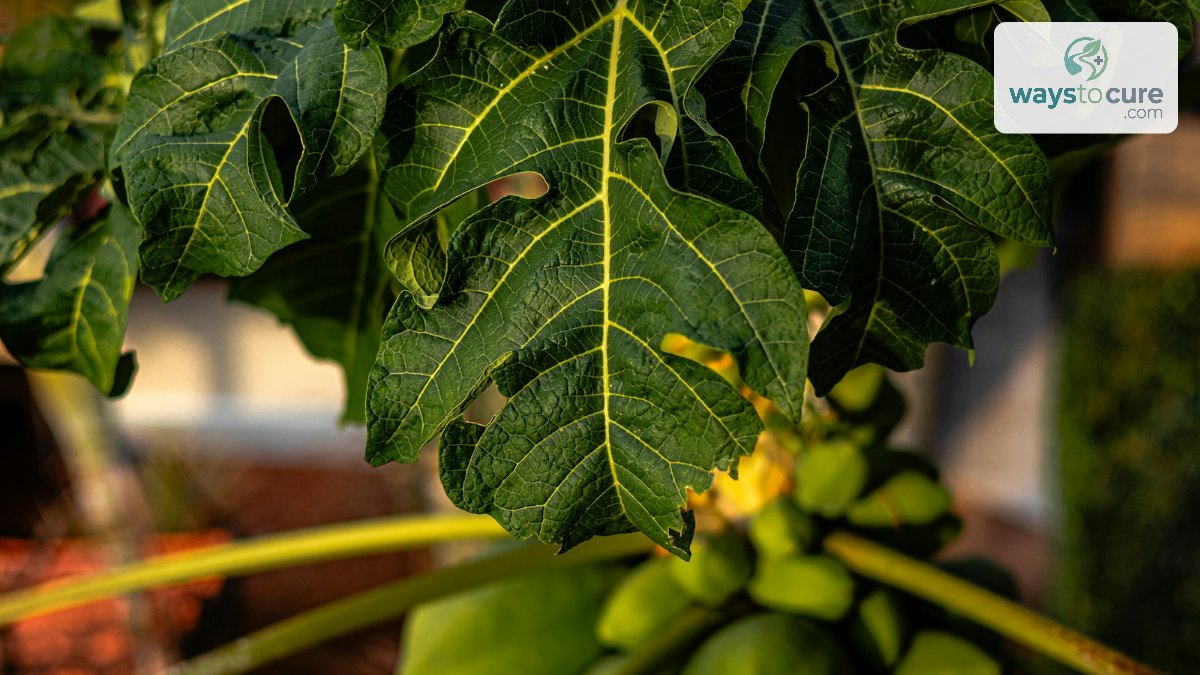
Papaya leaf extract has been tested in several small trials, mostly in India, and many of them found platelet counts rose a little faster and hospital stays were a day or two shorter. But the studies are small and low to moderate in quality, none showed fewer deaths or fewer cases of severe dengue, and a 2019 review of nine studies concluded that routine use can’t be recommended on current evidence.
So if a relative arrives with a glass of crushed papaya leaf juice, here’s what that juice can and can’t do, and why it never replaces the daily blood test and a doctor’s review.
What the Indian trials found
Most of the clinical research on papaya leaf (Carica papaya) for dengue comes from India. Three trials are quoted most often:
- A five-centre trial of 300 patients, published in the Journal of the Association of Physicians of India in 2016, was double-blind and placebo-controlled. Patients got a papaya leaf extract tablet three times a day for five days on top of standard care. Platelet counts rose significantly faster than with placebo, and side effects (mainly nausea and vomiting) were similar in both groups (Kasture and colleagues, 2016).
- A Rajasthan trial in the same journal gave a 500 mg extract capsule once daily for five days. Platelets were higher on days 3 to 5, but the difference was no longer significant by day 7. Hospital stay averaged 3.65 days against 5.42 days, and fewer platelet units were transfused (2016 study abstract).
- A Karnataka trial in 294 children aged 1 to 12 years gave papaya leaf extract syrup for five days alongside standard care. Platelet counts were significantly higher than in the control group, and two children had nausea. This trial was open-label, so families and doctors knew who got the syrup (2019 study).
What the meta-analyses say
Pooling trials together gives a clearer, and more cautious, picture.
A 2016 meta-analysis combined four randomised trials (439 people enrolled, 377 analysed). Papaya leaf groups had higher platelet counts after day 4, but there was no significant difference at 48 hours. The hospital-stay result came from a single study of 80 people. The authors noted that many details needed to judge bias weren’t reported, and that given the wide confidence interval, the platelet rise may be very small and may not matter clinically.
A larger 2019 systematic review and meta-analysis in BMC Complementary and Alternative Medicine included nine studies: six from India and one each from Pakistan, Indonesia and Malaysia. Seven reported higher platelet counts with papaya. Pooled data suggested about two days less in hospital, but the authors rated this as low-quality evidence. Their conclusion: the evidence is limited, based on a few trials of low to moderate quality, and routine use of papaya extract for dengue cannot be recommended.
| Study | Who and how many | Product used | Main finding | Key limit |
|---|---|---|---|---|
| Multicentre trial, India, 2016 | 300 adults, 5 centres | Extract tablet, 3 times a day, 5 days | Faster platelet rise than placebo | No data on severe dengue or deaths in the abstract |
| Rajasthan trial, 2016 | Dengue patients with low platelets | 500 mg capsule once daily, 5 days | Higher platelets days 3 to 5; shorter stay | No difference by day 7 |
| Karnataka paediatric trial, 2019 | 294 children, 1 to 12 years | Extract syrup, 5 days | Higher platelets than control | Open-label |
| Meta-analysis, 2016 | 4 trials, 377 analysed | Various extracts | Higher platelets after day 4 | Rise may not be clinically meaningful |
| Meta-analysis, 2019 | 9 studies | Juice, syrup, capsules, tablets | Higher platelets; about 2 fewer hospital days | Low-quality evidence; routine use not recommended |
Why the evidence is weaker than it looks
“Platelets went up faster” sounds convincing. These are the reasons researchers aren’t convinced yet, all drawn from the 2019 review:
- Poorly reported randomisation. Seven of the nine studies didn’t describe how patients were randomised, and several were open-label.
- Dropouts. In the Malaysian trial, only 111 of 145 patients in the papaya group and 119 of 145 controls completed the study.
- The wrong outcome. No study looked at deaths, and none measured plasma leakage or serious bleeding as outcomes. Those are what make dengue dangerous.
- Platelets aren’t the main threat. The review points out that platelet changes are only loosely linked to plasma leakage and shock.
- No agreed dose. Doses and products varied widely, and nobody has worked out an effective dose.
There’s one more catch. In dengue, platelets usually recover by themselves. The CDC describes the recovery phase, after the fever and the critical 24 to 48 hours, as the time when white cells rise and platelets follow. So if you drink papaya leaf juice on day 5 and your count improves on day 7, that may simply be the illness running its normal course.
Home-made juice is not what the trials tested
Most trials used standardised products: tablets, capsules or syrup with a fixed amount of extract. Only one study in the 2019 review used fresh juice, made from 50 g of leaves a day for three days.
Juice crushed at home has no fixed strength. The amount you get depends on the leaves, how much water goes in, and how much the patient can swallow. That means the trial results, modest as they are, can’t be applied directly to a glass of home-made juice.
Side effects and who should avoid it
The trials reported nausea and vomiting as the main side effects, and no serious adverse events. But the 2019 review notes that papaya leaves aren’t normally eaten as food and haven’t gone through formal early-phase safety testing, and it doesn’t discuss pregnancy at all.
Skip papaya leaf juice, or only take it if your treating doctor agrees, if you:
- Are pregnant or breastfeeding. The trials and reviews above give no safety data for pregnancy, and the US drugs-in-breastfeeding database LactMed notes there are no data on papaya in nursing mothers.
- Are allergic to papaya or to latex. LactMed notes that allergic reactions to papaya aren’t uncommon and that cross-reactions with latex have occurred.
- Are already vomiting. Vomiting at least 3 times in 24 hours is a dengue warning sign, and anything that adds to nausea makes it harder to keep fluids down.
- Are giving it to a young child without the paediatrician knowing.
- Take regular medicines for another condition. Tell your doctor about every herbal product you use; our guide on avoiding harmful supplement interactions explains why.
Eating ripe papaya fruit is a different matter from drinking leaf juice. For the fruit, see our articles on papaya nutrition and who should not eat papaya.
Why it can’t replace hospital monitoring
The dangerous part of dengue usually comes just after the fever settles, when plasma can leak out of blood vessels and blood pressure can fall. Papaya leaf hasn’t been shown to prevent that. What catches it in time is monitoring.
The CDC advises that people being treated at home are reviewed ideally every day, with a complete blood count daily or as the doctor judges necessary, and that anyone with warning signs is treated in hospital. Oral fluids are the main treatment for dengue without warning signs.
The real risk with home remedies is false reassurance. A family sees the count tick up after the juice, decides the danger has passed, and skips the next day’s test or ignores belly pain. For what the numbers on a CBC report mean, and how haematocrit and platelets are read together, see our guide to dengue platelet counts: what’s normal and when it’s dangerous.
If you still want to try it
Some families will use it anyway. If you do, keep it as an add-on and keep everything else going:
- Tell your doctor before the first dose, and mention it each time you’re reviewed
- Don’t let it replace water, ORS or other fluids; drinking enough matters far more
- Stop if it causes nausea or vomiting
- Keep every scheduled blood test, even if the platelet count looks better
- Keep checking for warning signs twice a day, especially in the 24 to 48 hours after the fever ends
For other monsoon fevers and how to prevent mosquito-borne illness at home, see our guide to common monsoon viral infections.
Go to hospital if…
Go to the nearest hospital, or call 112, if someone with dengue has any of these, whether or not they’ve had papaya leaf juice:
- Severe belly pain or tenderness
- Vomiting 3 or more times in 24 hours, or unable to keep fluids down
- Bleeding from the nose or gums, or blood in vomit or stool
- Rapid breathing, pale and cold skin, or extreme thirst and weakness
- Unusual tiredness, restlessness or irritability
- Very little urine over the day
Frequently asked questions
Does papaya leaf juice increase platelets in dengue?
Small trials, mostly of extract tablets, capsules and syrups, found platelet counts rose somewhat faster. The quality of that evidence is low to moderate, and the rise may not be clinically meaningful.
Does papaya leaf prevent severe dengue?
That hasn’t been shown. No trial measured deaths, and none looked at plasma leakage or serious bleeding as outcomes.
How much papaya leaf juice should I drink?
There’s no proven dose. Trials used different products and amounts, and the 2019 review said no effective dose has been worked out. Ask your doctor before taking any.
Is papaya leaf juice safe in pregnancy?
Its safety in pregnancy hasn’t been studied in the dengue trials, and the main 2019 review doesn’t address pregnancy at all. Avoid it unless your obstetrician specifically agrees.
Can I skip the platelet test if I’m taking papaya leaf?
No. Platelets often recover on their own, and the main danger in dengue is plasma leakage, which papaya leaf hasn’t been shown to prevent. Keep every test your doctor orders.
This article is for general information and is not a substitute for advice from a doctor. If you have symptoms or a health condition, please consult a qualified healthcare professional.