
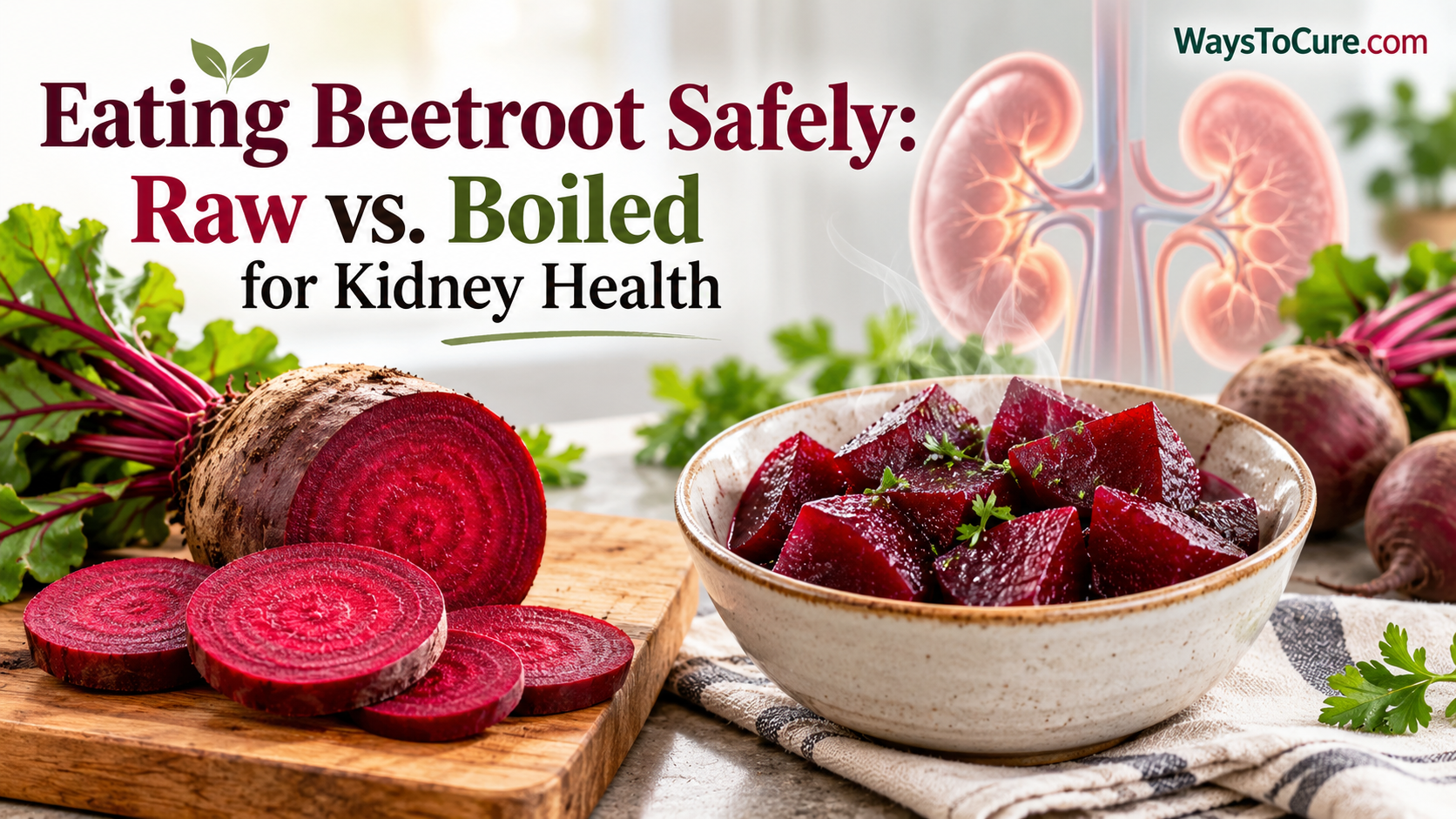
Beetroot is one of those foods that can create confusion for people concerned about kidney stones. It is rich in fiber, folate, potassium and naturally occurring plant compounds, yet it also contains oxalates. That matters because calcium oxalate stones are the most common causes and symptoms of kidney stones.
So, should you stop eating beetroot if you have kidney stones? Not necessarily.
The more useful question is how much beetroot you eat, how you prepare it, what type of kidney stone you have, and what the rest of your diet looks like.
For someone with a history of calcium oxalate stones, the difference between raw and boiled beetroot may be worth considering. Cooking in water can allow some soluble oxalate to move into the cooking water. However, the amount of oxalate in beetroot varies considerably between studies and samples, so boiling does not magically turn beetroot into a low-oxalate food.
This article explains the evidence behind raw vs boiled beetroot for kidney stones, how oxalate interacts with calcium, whether boiling reduces oxalates, and practical ways to include beetroot more safely in a kidney-stone-conscious diet.
Medical note: This article is for general education, not a substitute for medical advice. If you currently have kidney stones, chronic kidney disease, high urinary oxalate, recurrent stones, or another kidney condition, discuss your diet with your doctor or a registered dietitian.

Table of Contents
Is Beetroot Good or Bad for Kidney Health?
The answer depends on what you mean by “kidney health.”
For generally healthy people, beetroot can be part of a nutritious diet. It contains fiber, folate and various plant compounds. But a food can be nutritious overall and still require moderation for someone with a particular medical risk.
That distinction is especially important with kidney stones.
Beetroot is listed among foods that can be relatively high in oxalate. The National Kidney Foundation specifically includes beets among foods that people with calcium oxalate stones and elevated urinary oxalate may need to limit. At the same time, current kidney-stone guidance does not recommend that everyone follow an extremely restrictive low-oxalate diet.
Your individual risk matters more than the reputation of one food.
For example, someone who has never had a kidney stone and eats a small serving of beetroot occasionally has a very different situation from someone who repeatedly forms calcium oxalate stones and has high urinary oxalate on a 24-hour urine test.
That is why portion size, preparation and the overall diet are more useful concepts than simply labeling beetroot “good” or “bad.”
Why Does Beetroot Matter for Kidney Stones?
To understand the raw vs boiled question, it helps to understand oxalate.
Oxalate is a naturally occurring compound found in many plant foods. It can bind with minerals, including calcium. When oxalate is absorbed into the body and eventually reaches the urine, it can contribute to calcium oxalate crystal formation in people who are susceptible.
Calcium oxalate stones form when the urine contains conditions that favor crystal formation. Dehydration, high urinary calcium, high urinary oxalate and other metabolic factors can contribute to the process.
But there is an important detail that is often missed online.
Eating calcium does not automatically cause calcium oxalate stones.
In fact, getting enough calcium from food can help some people reduce oxalate absorption. Calcium can bind with oxalate in the digestive tract, making less oxalate available for absorption. The National Kidney Foundation therefore advises people with calcium stones not to unnecessarily eliminate dietary calcium.
This changes how you should think about beetroot.
Instead of asking:
“Does beetroot contain oxalate?”
The better questions are:
- How much beetroot am I eating?
- Is it raw or cooked?
- Do I have calcium oxalate stones?
- Is my urinary oxalate elevated?
- Am I drinking enough water?
- Am I getting adequate calcium from food?
- How much sodium and animal protein am I consuming?
- What did my 24-hour urine test show?
Those questions provide a much more useful picture.
Raw vs Boiled Beetroot for Kidney Stones
If you have been searching for raw vs boiled beetroot kidney stones, the short answer is this:
Boiling beetroot can reduce some oxalate, but the reduction is variable and does not make beetroot automatically safe in unlimited amounts for someone prone to calcium oxalate stones.
Research has consistently shown that oxalate can leach into cooking water. However, different vegetables and different cooking methods produce different results.
One study examining beetroot specifically found total oxalate of about 67 mg per 100 g in raw beetroot and about 52 mg per 100 g after boiling. The same review also reports other measurements showing substantial variation between samples.
Another study that tested beetroot among several vegetables reported approximately 67 mg of total oxalate per 100 g in raw beetroot and approximately 52 mg per 100 g after boiling. The researchers found that boiling significantly reduced oxalate in the tested vegetables, although the effect differed between foods and between soluble and insoluble oxalate.
This leads to an important practical point:
Boiled beetroot may be a better choice than raw beetroot when reducing dietary oxalate is a priority, but portion control still matters.
Does Boiling Beetroot Reduce Oxalates?
Yes, boiling can reduce some oxalates.
Oxalate exists in different forms, and some soluble oxalate can move out of plant tissue and into water during boiling. If you drain and discard that water, you also discard some of the oxalate that has leached into it.
A review of research on food oxalates explains that boiling can reduce soluble oxalate because of this leaching effect. Across vegetables studied, cooking produced substantial reductions in some cases, although the effect was not uniform.
However, there is no universal “boiling removes X% of beetroot oxalate” rule.
The amount removed depends on several factors:
- The variety of beetroot
- The original oxalate concentration
- How much water is used
- Cooking time
- Whether the beetroot is whole or cut
- Surface area exposed to water
- Whether the cooking water is discarded
- The laboratory method used to measure oxalate
Research has found considerable variation in reported oxalate levels among beets. One review of food oxalate data reported beet values ranging from approximately 36.9 to 794.12 mg per 100 g across different sources and samples. That enormous range illustrates why online oxalate charts should not be treated as perfectly precise measurements.
So, boiling helps, but it is not a guarantee.
Raw Beetroot vs Boiled Beetroot: Which Is Better?
If your primary concern is calcium oxalate kidney stones, boiled beetroot generally makes more sense than raw beetroot when you want to reduce some dietary oxalate.
Here is a simple comparison:
Factor Raw Beetroot Boiled Beetroot Oxalate Contains naturally occurring oxalate Some soluble oxalate can leach into water Kidney-stone concern More relevant if you need to restrict oxalate Potentially lower oxalate than raw Preparation No cooking required Requires cooking and draining Texture Firm and crunchy Softer Convenience Easy for salads and juices Easy as a cooked vegetable Best approach for high oxalate risk Smaller portions Smaller portions, with cooking water discarded The important word here is potentially.
Boiled beetroot is not automatically a “kidney-safe” food for everyone. If your doctor has specifically advised a low-oxalate diet because of recurrent calcium oxalate stones and high urinary oxalate, you may still need to limit beetroot even after cooking.
Beetroot Oxalates and Kidney Health: What You Need to Know
The relationship between dietary oxalate and kidney stones is more complicated than many social media posts suggest.
A person eats oxalate-containing food, but that does not mean every milligram of oxalate enters the urine.
Absorption varies depending on the food, the person’s digestive system, calcium intake and other factors.
Research has shown that dietary calcium can reduce oxalate absorption by binding oxalate in the intestine. Earlier research also found that restricting dietary calcium can increase oxalate absorption and urinary oxalate.
That is one reason why simply removing every food containing oxalate can be counterproductive.
A healthy diet contains many foods that naturally contain oxalate. The goal for most people is not to become afraid of every plant food. Instead, people with recurrent calcium oxalate stones should identify the foods and dietary patterns that matter for their individual risk.
Beetroot is not the only food that contains oxalates. Other foods may also require consideration depending on your individual kidney stone risk and overall diet. Our guide to oxalate-containing foods and kidney stone considerations explains this in more detail.
Who Should Be More Careful With Beetroot?
Not everyone needs to avoid beetroot.
You may need to pay more attention to portion size if you:
1. Have calcium oxalate kidney stones
Calcium oxalate stones are the most common kidney stones. If your stone analysis confirms this type, your doctor may recommend monitoring high-oxalate foods depending on your urinary results. National Kidney Foundation
2. Have high urinary oxalate
A 24-hour urine test can provide useful information about how much oxalate you are excreting and whether dietary changes may help.
If urinary oxalate remains high, foods such as beetroot may deserve more attention.
3. Have recurrent kidney stones
Someone who repeatedly develops stones needs a more personalized strategy than someone who had one isolated stone years ago.
The objective is not merely to remove beetroot. It is to identify why stones are forming.
4. Have been specifically advised to follow a low-oxalate diet
Follow the recommendation given by your healthcare professional rather than relying on generalized internet food lists.
5. Eat large quantities of beetroot regularly
Quantity matters.
A small serving occasionally is very different from consuming large amounts of beetroot juice or beetroot smoothies every day.
Can You Eat Beetroot If You Have Calcium Oxalate Stones?
Possibly, but moderation becomes important.
The National Kidney Foundation lists beets among foods that may need to be limited when someone forms calcium oxalate stones and has high urinary oxalate. However, it also emphasizes that a strict low-oxalate diet is not necessary for everyone.
This is an important distinction.
If you have calcium oxalate stones, don’t automatically assume that every oxalate-containing vegetable must disappear from your diet.
Instead, consider the complete dietary pattern.
For example, regularly eating large portions of beetroot while drinking very little water and consuming a high-sodium diet creates a different risk profile from eating a small serving of cooked beetroot alongside a balanced meal while maintaining good hydration and appropriate calcium intake.
Kidney-stone prevention involves several factors at once.
How to Eat Beetroot Safely for Kidney Health
If beetroot fits into your diet but you want to be cautious about oxalates, several practical strategies can help.
1. Prefer boiled beetroot if oxalate reduction is important
Boiling can allow some soluble oxalate to move into the cooking water.
Cook the beetroot thoroughly, drain the water and avoid using the cooking water in soups or drinks if you are deliberately trying to reduce oxalate exposure.
This is different from roasting.
Dry-heat methods such as roasting do not provide the same opportunity for water-soluble oxalate to leach into cooking water.
2. Keep portions reasonable
A common mistake is focusing entirely on whether a food is “allowed.”
Portion size often matters just as much.
If you have a history of calcium oxalate stones, eating a modest serving of beetroot occasionally may be easier to accommodate than consuming large quantities every day.
Your personal recommendation should depend on your urine results and overall diet.
3. Eat adequate calcium with meals
This is one of the most useful concepts in a calcium oxalate stone diet.
Calcium from food can bind oxalate in the digestive tract. That can reduce the amount of oxalate available for absorption.
The National Kidney Foundation generally recommends about 1,000 to 1,200 mg of calcium per day from food for many adults with calcium kidney stones, although individual needs vary. National Kidney Foundation
Examples of calcium-rich foods include:
- Milk
- Yogurt
- Cheese
- Calcium-fortified foods, when appropriate
The goal is not to take large amounts of calcium supplements without medical advice.
4. Do not throw away calcium-rich foods unnecessarily
There is a persistent misconception that calcium causes calcium stones.
It is more complicated than that.
For many people with calcium oxalate stones, getting too little dietary calcium can actually increase oxalate absorption.
That is why modern kidney-stone guidance generally favors adequate dietary calcium rather than unnecessary calcium restriction.
5. Drink enough water
If you are concerned about kidney stones, hydration should be much higher on your priority list than obsessing over a single vegetable.
Adequate fluid intake helps dilute substances in urine that can form crystals.
The National Kidney Foundation notes that many people with kidney stones should drink enough fluid to produce a substantial urine volume, with individual needs depending on their health and circumstances.
You may need more fluid in hot weather or when exercising because sweating reduces the amount of water available to produce urine.
This is particularly relevant in hot climates.
Is Beetroot Juice Safe for Kidney Stones?
Beetroot juice deserves a separate discussion.
Juicing can make it easy to consume a concentrated amount of a food quickly. Instead of eating a moderate portion of whole beetroot with a meal, you might drink several beets in a glass.
That changes the quantity consumed.
If you have calcium oxalate stones or elevated urinary oxalate, regularly drinking concentrated beetroot juice may therefore be less appropriate than eating a modest portion of cooked beetroot.
Juices also provide less fiber than whole vegetables.
This does not mean beetroot juice automatically causes kidney stones. It means that concentrated intake may make portion control more difficult.
The same principle applies to beetroot smoothies and “detox” drinks containing multiple high-oxalate ingredients.
The National Kidney Foundation specifically warns that some concentrated juices and “cleanses” can contain very high-oxalate ingredients.
What About Raw Beetroot Salad?
Raw beetroot can be part of a healthy diet for people who do not need to restrict oxalate.
But if you have recurrent calcium oxalate stones and your healthcare professional has asked you to reduce oxalate, cooked beetroot may be a more sensible preparation because boiling can remove some soluble oxalate.
A simple approach is to:
- Wash the beetroot thoroughly.
- Peel if desired.
- Cut it into manageable pieces.
- Boil it in water.
- Drain the cooking water.
- Serve a moderate portion with a balanced meal.
You do not need to turn every meal into a complicated kidney-stone diet experiment.
Does Roasting Beetroot Reduce Oxalates?
Roasting and baking are different from boiling.
When you boil beetroot, soluble compounds can move into the surrounding water.
When you roast beetroot, there is little or no water available for that same leaching process.
Therefore, if your specific goal is to reduce soluble oxalate, boiling and draining is generally more relevant than roasting.
That does not mean roasted beetroot is unhealthy.
It simply means that the cooking method matters when oxalate reduction is the specific objective.
What About Steaming Beetroot?
Steaming can also change oxalate levels, but it may not remove as much soluble oxalate as boiling because the vegetable has less direct contact with water.
Reviews of food-processing research generally find that boiling is an effective method for reducing soluble oxalate in many vegetables, although the response varies considerably between foods. PubMed Central (PMC)
If your doctor has specifically recommended reducing oxalate, boiling and discarding the water may therefore be preferable to steaming.
Beetroot and Kidney Stones: It Is Not Just About Oxalate
One of the biggest mistakes people make is focusing on oxalate while ignoring the rest of the diet.
Kidney stone formation involves multiple factors.
Hydration
Low urine volume allows stone-forming substances to become more concentrated.
Adequate fluid intake is one of the most important prevention strategies.
Sodium
A high-sodium diet can increase urinary calcium.
That can raise the risk of calcium-containing stones.
The National Kidney Foundation recommends limiting sodium and gives about 2,300 mg per day as a general target for many people, although individual advice may differ.
Calcium
Getting enough calcium from food can help reduce oxalate absorption.
So cutting out dairy or other calcium-rich foods simply because you have a “calcium stone” may not be the right strategy.
Animal protein
Large amounts of animal protein can affect urine chemistry and may increase the risk of certain types of stones, particularly uric acid stones.
Your stone type therefore matters.
Overall dietary pattern
A diet rich in vegetables, fruits and appropriate plant foods can support kidney-stone prevention.
The National Kidney Foundation notes that Mediterranean and DASH-style dietary patterns have been associated with fewer kidney stones.
This is why eliminating one vegetable rarely provides the complete solution.
Is Beetroot Safe for People With Normal Kidneys?
For people without a specific kidney-stone or kidney-disease concern, beetroot can generally fit into a varied, balanced diet.
Its oxalate content does not mean that healthy people need to avoid it.
The risk becomes more relevant when a person has a known tendency to form calcium oxalate stones, particularly when urine testing shows elevated oxalate.
Even then, the goal is usually targeted dietary adjustment rather than unnecessary fear of food.
That distinction can make a kidney-friendly diet much easier to follow over the long term.
How Much Beetroot Can You Eat With Kidney Stones?
There is no universally correct beetroot serving size for every person with kidney stones.
Why?
Because kidney-stone risk varies according to:
- Stone composition
- Urinary oxalate
- Urinary calcium
- Urine volume
- Urinary citrate
- Sodium intake
- Dietary calcium
- Medical conditions
- Medications
- Family history
- Previous stone history
A person with high urinary oxalate may need a different recommendation from someone whose primary issue is low urine volume.
This is why a blanket statement such as “50 grams is safe” or “100 grams is dangerous” can be misleading.
Your 24-hour urine test can provide much more useful information.
Calcium Oxalate Stones Diet: Where Does Beetroot Fit?
If you have calcium oxalate stones, think about your diet as a complete system.
Instead of building meals around a list of forbidden foods, focus on several priorities.
Prioritize hydration
Drink enough fluid to maintain good urine volume.
Keep sodium under control
Reduce heavily salted packaged foods, fast foods and highly processed meals.
Get adequate dietary calcium
Include appropriate calcium-rich foods with meals.
Moderate very high-oxalate foods
If your urinary oxalate is high, your doctor or dietitian may recommend limiting foods such as spinach, beetroot, rhubarb, nuts or other high-oxalate choices.
Avoid excessive animal protein
Especially if your overall stone profile suggests it contributes to your risk.
Do not rely on supplements casually
Large doses of certain supplements can affect stone risk. The National Kidney Foundation specifically advises caution with high-dose vitamin C and certain other supplements in people prone to stones.
Can Boiled Beetroot Prevent Kidney Stones?
No.
This is an important distinction.
Boiling can reduce some oxalate, but boiled beetroot is not a kidney-stone prevention treatment.
You should not assume that cooking beetroot eliminates its potential contribution to urinary oxalate.
Likewise, eating beetroot does not automatically cause kidney stones.
Stone prevention depends on the complete picture, including fluid intake, urinary chemistry, dietary calcium, sodium, protein and individual metabolic factors.
Should You Avoid Beetroot Completely?
For most people, no.
Even among people with kidney stones, complete avoidance may not always be necessary.
The National Kidney Foundation explains that a strict low-oxalate diet is not appropriate for everyone. It may be more useful to limit very high-oxalate foods when someone has calcium oxalate stones and elevated urinary oxalate.
That is a much more practical approach.
Instead of thinking:
“I have kidney stones, so I can never eat beetroot.”
Think:
“I have kidney stones, so I need to understand whether oxalate is an important factor in my case and adjust my portion and preparation accordingly.”
That mindset is both more accurate and easier to maintain.
Raw vs Boiled Beetroot: A Practical Decision Guide
Here is a simple way to approach the choice.
If you have healthy kidneys and no history of stones
You can generally enjoy beetroot as part of a varied diet.
If you have had one kidney stone
Find out what type of stone you had before making major dietary restrictions.
Discuss your dietary oxalate intake with your doctor or kidney dietitian.
If your urinary oxalate is high
Consider limiting very high-oxalate foods as advised by your healthcare professional. Boiling and draining beetroot can reduce some soluble oxalate.
Consider reducing portion size and choosing boiled beetroot rather than consuming large quantities raw or as juice.
If you drink beetroot juice daily
Ask whether the concentrated intake is appropriate for your stone profile.
If you have chronic kidney disease
Do not assume general kidney-stone advice applies to you. Your potassium, phosphorus, fluid and other dietary needs may require a separate plan.
Other High-Oxalate Foods to Watch
Beetroot is not the only food that contains substantial oxalate.
Depending on the source and preparation, foods commonly discussed in relation to high oxalate include:
- Spinach
- Swiss chard
- Rhubarb
- Almonds
- Peanuts
- Chocolate
- Tea
- Sweet potatoes
- Certain beans
- Beets
The National Kidney Foundation identifies several of these foods as particularly relevant for people with calcium oxalate stones and high urinary oxalate.
However, food oxalate values can vary substantially between databases and studies. One scientific review found considerable differences in reported oxalate concentrations, which means online “safe food” lists should be interpreted cautiously.
Why Portion Size Matters More Than Many People Realize
Imagine two people.
Person A eats a small serving of cooked beetroot with lunch once or twice a week.
Person B drinks a large beetroot smoothie every morning containing several beets, spinach, nuts and other high-oxalate ingredients.
Both technically “eat beetroot.”
But their dietary exposure is completely different.
This illustrates why a food’s presence on a high-oxalate list does not tell you everything about personal risk.
For someone prone to calcium oxalate stones, concentrated smoothies can be particularly problematic because they make it easy to consume large quantities of several oxalate-rich foods at once.
A Kidney-Stone-Friendly Way to Serve Beetroot
If your healthcare professional says beetroot can remain in your diet, try a simple preparation.
Boiled beetroot with yogurt and herbs
Boil beetroot until tender, drain the cooking water and allow it to cool. Serve a moderate portion alongside plain yogurt and a balanced meal.
The yogurt provides dietary calcium, while the boiled preparation can reduce some soluble oxalate compared with the raw vegetable.
Of course, this is not a treatment for kidney stones. It is simply an example of how beetroot can fit into a balanced meal.
If you have been instructed to restrict potassium, dairy or certain other foods because of kidney disease, ask your healthcare professional before using this combination.
When Should You See a Doctor About Kidney Stones?
Diet can help prevent some stones, but it cannot replace medical evaluation.
Seek medical care if you have symptoms such as:
- Severe pain in the back, side or abdomen
- Blood in the urine
- Fever or chills
- Nausea or vomiting
- Difficulty passing urine
- Pain accompanied by signs of infection
- Recurrent kidney stones
- Known kidney disease
A blocked urinary tract combined with infection can become a serious medical problem.
If you repeatedly develop stones, ask your healthcare professional whether the stone can be analyzed and whether a 24-hour urine test would help identify the factors contributing to stone formation. The National Kidney Foundation recommends individualized evaluation because stone prevention depends on stone type and urine chemistry.
Is raw beetroot bad for kidney stones?
Not automatically. Raw beetroot contains oxalate, which can matter for people who form calcium oxalate stones. If you have high urinary oxalate, your doctor may recommend limiting beetroot or other high-oxalate foods.
Does boiling beetroot reduce oxalates?
Yes, boiling can reduce some oxalate, particularly soluble oxalate, because some of it leaches into the cooking water. The reduction varies depending on the food and cooking conditions.
Is boiled beetroot better than raw beetroot for kidney stones?
If reducing dietary oxalate is a priority, boiled beetroot may be preferable because some soluble oxalate can be removed with the cooking water. However, boiled beetroot still contains oxalate.
Can I eat beetroot if I have calcium oxalate stones?
Possibly. Your individual urinary oxalate level, stone history and overall diet matter. People with calcium oxalate stones and high urinary oxalate may need to limit beetroot.
Should I stop eating calcium if I have calcium kidney stones?
Usually, no. Adequate calcium from food can help bind oxalate in the digestive tract. Unnecessary calcium restriction may actually increase oxalate absorption.
Is beetroot juice safe if I have kidney stones?
It depends on your stone type and urinary chemistry. Large quantities of beetroot juice can provide a concentrated amount of beetroot, so people who need to restrict oxalate should discuss regular beetroot juice consumption with their healthcare professional.
Does beetroot cause kidney stones?
Beetroot does not automatically cause kidney stones. However, it contains oxalate, and dietary oxalate can contribute to calcium oxalate stone risk in susceptible individuals.
Can boiling completely remove beetroot oxalates?
No. Boiling can reduce some oxalate, but it does not remove all oxalate. Beetroot remains an oxalate-containing food after cooking.
Is beetroot good for kidney health?
For people with healthy kidneys, beetroot can be part of a balanced diet. For people with kidney stones or kidney disease, the appropriate amount depends on the individual’s medical and nutritional needs.
The Bottom Line: Raw vs Boiled Beetroot for Kidney Health
Beetroot does not deserve to be labeled simply as “good” or “bad” for the kidneys.
For most healthy people, it can be a nutritious vegetable. But for people prone to calcium oxalate kidney stones, beetroot deserves more attention because it contains oxalate.
The evidence suggests that boiling can reduce some soluble oxalate, especially when the cooking water is discarded. However, the amount removed varies, and beetroot can still contain meaningful oxalate after cooking.
If you have calcium oxalate stones, a sensible approach is to:
- Find out your stone type.
- Ask whether you have high urinary oxalate.
- Keep beetroot portions moderate if oxalate is a concern.
- Prefer boiling and draining when you want to reduce soluble oxalate.
- Avoid assuming that beetroot juice is automatically healthier than whole beetroot.
- Get adequate calcium from food unless your doctor advises otherwise.
- Drink enough fluid to maintain good urine volume.
- Keep sodium intake under control.
- Avoid excessive animal protein when appropriate for your stone type.
- Use your 24-hour urine results to guide major dietary changes.
The most important takeaway is that kidney-stone prevention is about the whole dietary pattern, not one food.
If you enjoy beetroot and have kidney-stone concerns, you do not necessarily need to eliminate it forever. In many cases, the smarter approach is to understand your individual risk, control portions, choose an appropriate cooking method and build the rest of your diet around proven kidney-stone prevention principles.
For anyone with recurrent stones, high urinary oxalate, chronic kidney disease or a complicated medical history, a doctor or registered kidney dietitian can provide advice tailored to your test results rather than relying on a generic food list.