
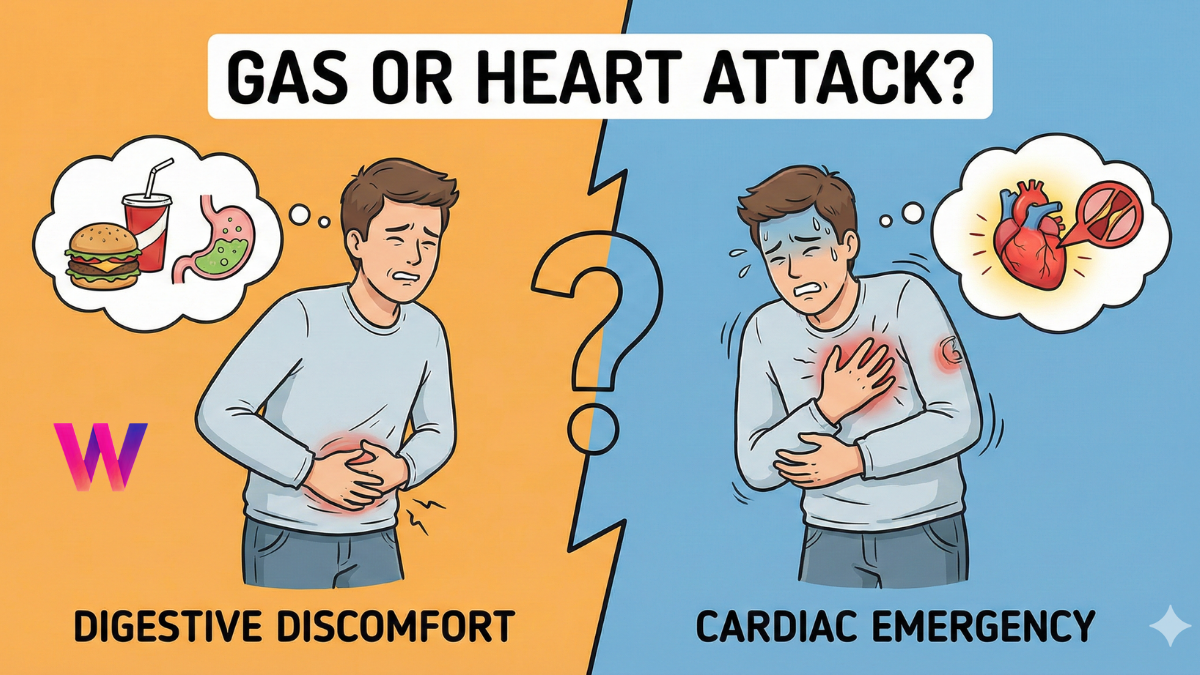
It starts with a twinge in the center of your chest. Or perhaps it’s a heavy, dull pressure. Your mind immediately races to the worst-case scenario. Is this it? Is this a heart attack? Or did you just eat that spicy burrito too quickly?
This specific moment of panic is one of the most common human experiences in modern health. The overlap between the digestive system and the cardiovascular system is a biological cruelty; two vastly different conditions—one a minor nuisance, the other life-threatening—share an alarmingly similar set of symptoms.
Understanding the difference is not just about peace of mind; it is a vital survival skill. Every second counts when the heart is involved. However, unnecessary trips to the ER for trapped wind can be costly and stressful.
This comprehensive guide will dissect the nuances of chest pain, exploring the biological reasons for the confusion, the specific “tells” that distinguish gas from cardiac arrest, and the silent symptoms that often go unnoticed until it is too late.


Table of Contents
The Biological “Cross-Wiring”: Why Gas and Heart Attacks Feel Similar
To understand how to differentiate the pain, we must first understand why they feel so similar. The answer lies in your nervous system.
The nerves that serve the heart and the nerves that serve the esophagus, stomach, and gallbladder often travel along the same pathways to the brain. specifically, the Vagus nerve plays a massive role here. This creates a phenomenon known as “referred pain” or visceral convergence.
When your stomach is distended with gas, it pushes upward against the diaphragm. This pressure can radiate into the chest cavity. Because the brain isn’t always great at pinpointing the exact source of internal (visceral) pain, it may interpret a signal from the upper abdomen as coming from the chest. Conversely, a heart experiencing ischemia (lack of blood flow) can send pain signals that the brain misinterprets as indigestion or upper back pain.
This biological confusion is why relying on “gut feeling” isn’t enough. We need to look at the data: the specific characteristics of the pain.
Anatomy of Gas Pain: Sharp, Moving, and Predictable
Gas pain is essentially trapped air. It occurs when gas builds up in your digestive tract due to swallowing air or the breakdown of food by bacteria in the colon. When this gas accumulates, it distends the intestinal walls, triggering pain receptors.
The “Flavor” of Gas Pain
People suffering from severe gas pain usually describe the sensation using specific adjectives that differ from cardiac patients:
- Sharp and Stabbing: Gas pain often feels like a knife-like stitch. It is acute and piercing rather than heavy.
- Migratory: This is a key differentiator. Gas moves. You might feel the pain in your upper left chest, but five minutes later, it might shift to your lower abdomen or your side.
- Intermittent: Gas pain tends to come in waves. It peaks, then subsides, then returns. It is rarely a constant, unrelenting pressure for hours on end without fluctuation.
The Physical Triggers
If you can link the pain to a specific mechanical action, it is more likely to be gas or musculoskeletal issues:
- The Belch Factor: If you burp or pass gas and feel immediate, even if partial, relief, the culprit is almost certainly digestive.
- Position Sensitivity: If lying flat makes it worse, but sitting up and leaning forward makes it better (or vice versa), it suggests a digestive or skeletal issue.
- Touch Sensitivity: Press your fingers on your chest or abdomen. If you can reproduce the pain or make it worse by pressing on a specific spot, it is likely gas distension or chest wall inflammation, not your heart. The heart is protected by the ribcage and cannot be “touched” from the outside.
Common Culprits
Review your last 4 hours. Did you consume:
- Carbonated beverages?
- Beans, lentils, or cruciferous vegetables (broccoli, cabbage)?
- Dairy products (if you are lactose sensitive)?
- Artificial sweeteners (sorbitol or xylitol)?
Anatomy of a Heart Attack: Pressure, Radiating, and Relentless
A heart attack (myocardial infarction) occurs when blood flow to a part of the heart muscle is blocked, usually by a clot. The muscle begins to die, sending urgent distress signals.
The “Flavor” of Cardiac Pain
Unlike the sharp stab of gas, heart pain is often described as visceral pressure.
- The Elephant: The classic description is “an elephant sitting on my chest.” It feels like squeezing, fullness, or heavy pressure.
- Centralized then Radiating: The pain usually starts in the center or left side of the chest. Crucially, it travels. It moves outward rather than shifting location entirely. It radiates to the left arm, the neck, the jaw, or the back (between the shoulder blades).
- Unrelenting: Heart attack pain typically lasts more than a few minutes. It does not disappear if you burp. It does not vanish if you drink water. It is a constant, nagging presence that may wax and wane in intensity but rarely goes away completely.
The “Whole Body” Response
The heart is the engine of the body. When it fails, the whole system reacts. Look for these systemic signs that rarely accompany simple gas:
- The Cold Sweat: This is a major red flag. If you break out into a clammy, cold sweat for no apparent reason while experiencing chest discomfort, call 911.
- Shortness of Breath: Are you winded just by sitting there? Do you feel like you’ve run a marathon while watching TV? This indicates the heart is struggling to pump oxygenated blood.
- Lightheadedness: A drop in blood pressure can cause severe dizziness or near-fainting.
The Critical Comparison Table
To make this as scannable as possible, here is a direct comparison of the symptoms.
| Feature | Likely Gas / Indigestion | Likely Heart Attack |
| Type of Pain | Sharp, stabbing, piercing. | Dull pressure, squeezing, heaviness, burning. |
| Duration | Seconds to minutes; comes and goes. | Lasts more than 5 minutes; constant or slowly building. |
| Movement | Pain changes when you twist, bend, or lie down. | Pain remains the same regardless of body position. |
| Touch | Chest is tender to the touch. | Chest does not hurt when touched externally. |
| Relief | Burping or passing gas brings relief. | Antacids/burping provide no relief. Rest doesn’t help. |
| Radiating | Rarely radiates to jaw/arm (though can go to back). | Frequently radiates to left arm, neck, jaw, or shoulder blades. |
| Associated Symptoms | Bloating, sour taste in mouth. | Cold sweat, nausea, shortness of breath, doom. |
The Silent Killers: Atypical Symptoms in Women and the Elderly
Medical literature and Hollywood movies have historically focused on the “male” presentation of a heart attack: the dramatic clutching of the chest and collapsing. However, this stereotype is dangerous.
Women, the elderly, and people with diabetes often experience “silent” heart attacks or atypical symptoms that mimic indigestion almost perfectly.
The “Flu” Trap
Many women report that their heart attack felt like a sudden onset of the flu.
- Extreme Fatigue: Not just “tired,” but an overwhelming exhaustion where lifting a limb feels difficult.
- Nausea and Vomiting: Because the heart sits just above the stomach, cardiac distress can trigger severe nausea, leading people to think they have food poisoning or gas.
- Jaw and Back Pain: Women are more likely to experience pain in the jaw or upper back without the classic chest pressure.
If you are a woman over 50 or a diabetic and you experience sudden nausea, sweating, and jaw pain without chest pain, treat it as a cardiac emergency. Do not assume it is lunch disagreeing with you.
The “Exertion Test”: A Vital Clue
One of the most reliable ways to distinguish between a digestive issue and a cardiac issue (specifically angina, which is a precursor to a heart attack) is the exertion test.
Scenario A: You are walking up a flight of stairs. You feel a tightness in your chest. You stop and rest for two minutes. The pain goes away. You start walking again, and the pain returns.
- Verdict: This is Angina. The heart demands more oxygen during exercise; if arteries are narrowed, the heart cries out in pain. When you rest, demand drops, and pain subsides. This requires immediate medical attention.
Scenario B: You are sitting on the couch watching a movie and feel sharp pain. You get up to walk around the room, and the pain actually feels slightly better or stays exactly the same.
- Verdict: This is likely Gas or Musculoskeletal. Heart pain is rarely “walked off.” In fact, walking usually makes heart pain worse because it places more load on the organ.
Other Imposters: It Might Not Be Gas OR a Heart Attack
While gas and heart attacks are the main contenders, there is a “Big 5” of chest pain causes that you should be aware of.
1. GERD (Gastroesophageal Reflux Disease)
Acid reflux causes a burning sensation behind the breastbone.
- Differentiation: Reflux usually leaves a sour taste in the mouth and worsens when lying flat immediately after eating. Antacids usually provide quick relief.
2. Costochondritis
This is inflammation of the cartilage that connects a rib to the breastbone. It is frighteningly painful and sharp.
- Differentiation: The “Poke Test.” If you press your finger on the sternum and you scream in pain, it is Costochondritis. You cannot reproduce heart attack pain by poking your skin.
3. Panic Attacks
Anxiety can cause chest tightness, racing heart, and shortness of breath.
- Differentiation: Panic attacks are often accompanied by hyperventilation and tingling in the hands or lips. However, because panic attacks mimic heart attacks so closely, a “diagnosis of exclusion” is needed. Never assume it’s “just anxiety” if it’s your first time feeling it.
4. Pulmonary Embolism (PE)
A blood clot in the lung.
- Differentiation: The pain is sharp and worsens dramatically when you take a deep breath (pleuritic pain). It is almost always accompanied by sudden, severe shortness of breath and a rapid heart rate. This is a life-threatening emergency.
Diagnostics: What Happens at the ER?
If you go to the ER (and you should, if you are unsure), do not feel embarrassed if it turns out to be gas. Doctors prefer you to come in for gas than to stay home with a heart attack.
Here is how they tell the difference quickly:
- The EKG (Electrocardiogram): This measures the electrical activity of the heart. It can detect if the heart is beating abnormally or if muscle damage is occurring.
- Troponin Blood Test: When heart muscle is damaged, it leaks a protein called Troponin into the bloodstream. High Troponin levels are the smoking gun of a heart attack.
- Chest X-Ray: This checks for lung issues (like pneumonia or collapsed lung) and checks the size of the heart.
- GI Cocktail: Sometimes, if the doctor suspects GERD/Gas, they may give you a “GI Cocktail” (a mix of liquid antacid and lidocaine). If the pain vanishes immediately after drinking it, the heart is likely fine.
Immediate Actions: What to Do in the “Grey Zone”
You are alone at home. You feel the pain. You aren’t sure. Here is your action plan.
Step 1: Stop and Assess
Stop whatever you are doing. Sit down. Do not ignore it. Do not try to “push through.”
Step 2: Check the “Red Flags”
- Is the pain radiating to the arm/jaw?
- Are you sweating cold sweat?
- Is there pressure/squeezing?
- Do you feel a sense of doom?
Step 3: When in Doubt, Call 911
If the pain lasts more than 5 minutes and has any of the red flags above, call emergency services. Do not drive yourself. Paramedics can start treatment (like oxygen and nitroglycerin) in the ambulance.
Step 4: Aspirin (If advised)
If you suspect a heart attack and are waiting for the ambulance, chew (do not just swallow) a standard 325mg aspirin, provided you are not allergic and have no bleeding disorders. Chewing gets it into the bloodstream faster to help thin the blood and reduce the clot size.
Prevention: Playing the Long Game
The best way to avoid the “Gas or Heart Attack” dilemma is to improve the health of both systems. Interestingly, the lifestyle changes for both overlap significantly.
1. The High-Fiber, Heart-Healthy Diet
A diet rich in fiber regulates digestion (reducing constipation and gas) and lowers cholesterol (reducing heart attack risk).
- Caveat: Introduce fiber slowly. A sudden increase in fiber can cause massive gas, leading you right back to the panic.
2. Mindful Eating
Eating too fast causes you to swallow air (aerophagia), leading to gas pain. Eating huge meals diverts blood flow to the gut, which can actually trigger angina in people with compromised hearts.
- Strategy: Eat smaller, more frequent meals. Chew slowly.
3. Stress Management
Stress causes the stomach to produce more acid (heartburn/gas) and causes the heart to beat faster and blood pressure to rise. Yoga, meditation, and regular walking are non-negotiable for long-term health.
4. Know Your Numbers
If you have high cholesterol, high blood pressure, or a family history of heart disease, your threshold for going to the ER should be much lower. Gas pain is annoying; heart disease is silent until it isn’t. Regular checkups remove the mystery.
FAQ: Common Questions About Chest Pain
To ensure you have absolutely every answer you need, here are the most frequently asked questions regarding this confusion.
Q: Can gas cause pain in the left arm? A: Generally, no. Gas pain is typically centered in the abdomen or lower chest. While it can radiate to the back, it rarely travels down the left arm. Left arm pain is a classic cardiac symptom.
Q: Can a heart attack feel like a burning sensation? A: Yes. This is why it is often confused with heartburn. However, cardiac “burning” usually comes with pressure or squeezing, whereas heartburn burning is usually acidic and travels up the throat.
Q: I’m young (20s or 30s). Can I have a heart attack? A: While less common, it is possible, especially with genetic conditions, substance use, or extreme lifestyle factors. However, in young, healthy individuals, sharp chest pain is statistically more likely to be anxiety, costochondritis, or gas.
Q: Does drinking water help a heart attack? A: No. Drinking water might help clear acid reflux or settle the stomach, but it will do nothing for a blockage in a coronary artery. If water resolves the pain, it was likely not your heart.
Q: Can I have a heart attack with normal blood pressure? A: Yes. You can have a blockage even if your blood pressure is managed. Do not rely on a home blood pressure cuff to rule out a heart attack during an active pain event.
Conclusion: How to Know If It’s Gas or a Heart Attack?
The human body is complex, and the signals it sends can be ambiguous. The difference between the sharp, migrating stab of trapped gas and the crushing, radiating pressure of a heart attack is usually distinct—but not always.
If there is one takeaway from this guide, let it be this: Embarrassment is not a side effect of survival.
Many people die from heart attacks because they were too polite to call an ambulance, or too convinced it was “just the onions” they ate at dinner. It is always better to spend a few hours in the ER feeling a little foolish for a gas diagnosis than to ignore a life-threatening cardiac event.
Pay attention to the nuances: the sweat, the radiation, the exertion factors. Treat your body with the seriousness it deserves. If the warning light on your car’s dashboard started flashing, you’d pull over. Do the same for your heart.
Stay informed, stay calm, and prioritize your health.
Disclaimer: The information provided in this article is for educational purposes only and does not constitute medical advice, diagnosis, or treatment. If you or someone else is experiencing severe chest pain, difficulty breathing, or other alarming symptoms, do not rely on the internet. Call emergency services immediately.