
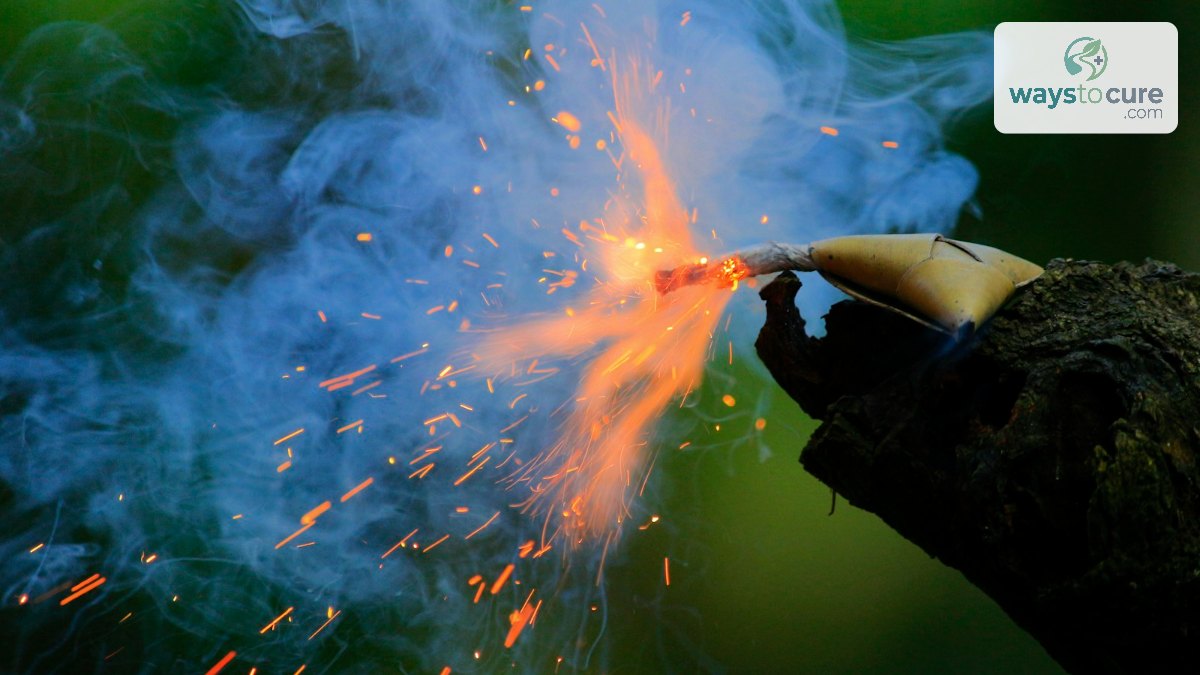
If smoke, ash or a speck from a cracker gets into your eye, rinse it with clean running water and don’t rub it. If a cracker has hit the eye, burnt it, or left anything stuck in it, don’t rinse it or press on it: cover it loosely with a shield and go to an eye hospital or emergency department straight away.
Diwali is on Sunday, 8 November this year. Eye hospitals see a spike in injuries over the festival nights, and many of the people hurt are children who were only watching. Here’s what to do in the first few minutes, what not to do, and when it can’t wait.
Smoke irritation or a real injury: how to tell
| What happened | What it usually looks like | What to do |
|---|---|---|
| Smoke or haze from crackers | Both eyes watery, red and stinging; vision clear once you blink | Move away from the smoke, rinse with clean water, rest |
| Ash, dust or a tiny speck | Gritty feeling in one eye, watering | Blink, rinse with clean water; see a doctor if it won’t clear |
| Chemical or powder from a cracker in the eye | Burning pain, redness, watering | Rinse with running water for at least 20 minutes, then go to hospital |
| Hit by a cracker, stick or rocket (blunt injury) | Pain, swelling, black eye, blood in the eye, blurred vision | Cold compress without pressure, then hospital the same night |
| Something stuck in the eye, a cut, or a burst cracker close to the face | Severe pain, bleeding, visible object, odd-shaped pupil, vision loss | Don’t rinse or remove anything; shield the eye and go to hospital immediately |
If you can’t tell which row you’re in, treat it as the more serious one.
First aid for smoke, ash and small specks
Cracker smoke irritates the surface of the eye, and the same smoke is hard on the lungs. (If anyone at home has breathing problems, see our guide on protecting your lungs when the AQI is above 300, and our look at whether N95 masks work against pollution. A mask protects your lungs, not your eyes.) For irritated eyes:
- Move indoors or away from where crackers are being burst.
- Wash your hands, then rinse the eye with plenty of clean, lukewarm or cool tap water or sterile saline.
- For a speck, the American Academy of Ophthalmology (AAO) suggests blinking several times, or gently lifting the upper lid over the lower lashes so the lashes can brush it out, and then flushing with water or saline.
- Don’t rub. Rubbing can drag a particle across the clear front of the eye (the cornea) and scratch it.
- Take out contact lenses, and don’t put them back until the eye has settled.
The AAO warns that bits of metal, glass or other hard material can embed in the eye. With crackers, that can include fragments of the casing. If the gritty feeling doesn’t go after rinsing, or you can see something but can’t wash it out, see a doctor promptly.
Chemical splash: keep rinsing for 20 minutes
Cracker powder or burnt residue in the eye can cause a chemical burn. Speed matters more than anything else here.
- Hold the eye open and run clean, cool (not hot) water over it. The NHS advises rinsing for at least 20 minutes, with the flow gentle enough to keep the eye open under it.
- Turn the head so the water runs away from the other eye.
- Keep rinsing on the way to hospital if you can, using a bottle of clean drinking water.
- Take the packet or container with you if you know what got in.
Get it checked by an eye doctor the same day, even if the eye feels better after rinsing.
Blunt, burn and penetrating injuries: shield the eye and go
These are the injuries that can cost sight. For a cut, a puncture, or anything stuck in the eye, the AAO’s advice is:
- Don’t rinse the eye with water.
- Don’t remove anything stuck in the eye, however small it looks.
- Don’t rub or press on the eye.
- Shield the eye without letting the shield touch it. The bottom of a paper or plastic cup taped over the eye socket works.
- Don’t give aspirin or ibuprofen for the pain. They thin the blood and may increase bleeding inside the eye.
- Don’t put any ointment or drops in.
- Get to emergency care straight away. Call 112 if you can’t get there quickly.
For a blow to the eye without any cut, a small cold compress held gently against the area (not pressing on the eyeball) can ease pain and swelling. Even after a light blow, the AAO advises seeing an eye doctor promptly if there’s a black eye, pain or any change in vision.
Spark burns to the eyelid or around the eye need the same urgency. Skin burns elsewhere are a separate topic, which we cover in our burns first-aid guide.
What not to put in an injured eye
In India, many families reach for a home remedy first. In a population study in rural Haryana (PLoS One, 2017), about a quarter of people asked had used home remedies for eye problems. The most common were kajal, honey, ghee and rose water, and a few people had used breast milk. The authors describe how these remedies can carry infection, damage the surface of the cornea, and delay proper treatment, contributing to corneal ulcers.
After a firecracker injury, don’t put any of these in the eye:
- Rose water, ghee, honey or oil
- Breast milk or any other milk
- Kajal or surma
- Leftover eye drops from a previous illness, especially steroid drops
- Ice placed directly on the eye
Use only clean water, and only for smoke, specks and chemicals. For anything else, use a shield and get to hospital.
Who gets hurt: children and bystanders
- At the Dr Rajendra Prasad Centre for Ophthalmic Sciences, AIIMS New Delhi, 68 people with firecracker eye injuries were seen over 10 days around Diwali 2017, down from 168 in the same period the year before, when crackers were still on sale in Delhi. Of the 68, about 62% were under 18, and most were bystanders rather than the person lighting the cracker. More than 80% had open-globe injuries, meaning the wall of the eye had been torn or ruptured.
- A multicentre study from Central and Western India (Indian Journal of Ophthalmology, 2026) followed 67 patients over Diwali 2023 and 2024. Nearly 63% were children, 90% were male, and about a third were bystanders. “Bomb”-type crackers caused 57% of injuries, followed by fountains and sparklers (18%) and rockets (15%). More than 40% could see worse than 6/60 when they arrived, and about a quarter needed surgery.
The takeaway: you don’t have to be holding the cracker to be hurt. Children standing close to watch are among the most exposed.
Protective eyewear and safer habits
Polycarbonate safety goggles, the kind sold for workshop use, look like the best protection. In a lab test reported in the Indian Journal of Ophthalmology in 2026, researchers set off a “bullet bomb” cracker half a metre from a mannequin fitted with goat eyes. With polycarbonate safety goggles on, none of 10 blasts got through and the eyes weren’t damaged. Without goggles, the eyes were badly damaged. It was a bench test, not a study in people. Still, a pair of goggles costs far less than treatment: in the Central and Western India study above, the average cost of care was about ₹31,500 per patient.
Other habits that help:
- Have one adult light crackers. Children should watch from a distance, not lean over to check why one hasn’t gone off.
- Never relight a dud. Wait, then soak it in a bucket of water.
- Light crackers at arm’s length, in an open space, and step back straight away.
- Keep a bucket of water nearby, and a bottle of clean water for rinsing eyes.
- Hold sparklers away from the face and other people, and drop used ones into water.
- Avoid loose clothing such as dupattas and saree pallus near flames.
If a child has asthma, the smoke is a risk too. Our article on warning signs of pollution-triggered asthma in children lists what to watch for.
Go to hospital if…
Go to an eye hospital or emergency department straight away, or call 112, if any of these follow a cracker injury (based on NHS and AAO advice):
- Something has hit the eye at speed, or a cracker burst close to the face
- Anything is stuck in the eye, or you can see a cut on the eye or eyelid
- Vision is blurred, dimmed or lost, or you see double
- Severe pain, or pain that keeps going after rinsing
- Blood in the clear front part of the eye, or blood or pus coming from the eye
- The pupil looks an unusual size or shape compared with the other eye
- The eye can’t open, or one eye doesn’t move as well as the other or sticks out more
- Headache, sensitivity to light, or feeling sick or vomiting after the injury
- Any chemical in the eye, even if it feels better after rinsing
Don’t drive yourself. Ask someone else to take you. If only smoke irritation is the problem and it hasn’t cleared within 24 hours, see a doctor the next day.
Frequently asked questions
Can I wash my eye with rose water after cracker smoke?
Use clean tap water or sterile saline instead. Rose water and other home remedies aren’t sterile and can carry infection into an irritated eye.
My child’s eye is red after watching crackers but they can see fine. Is it serious?
Mild redness and watering in both eyes after smoke usually settles with rinsing and rest. Go to a doctor if there’s pain, one eye is much worse, vision is blurred, or it hasn’t settled by the next day.
Should I try to remove a piece of cracker stuck in the eye?
No. Leave it in place, cover the eye with a shield that doesn’t touch it, and go to hospital. Removing it can make the injury much worse.
Can I give painkillers on the way to hospital?
Avoid aspirin and ibuprofen, which can increase bleeding. Tell the doctor about any medicine already taken.
Do sunglasses protect against firecracker injuries?
Don’t count on them. Most sunglasses aren’t made to stop a flying fragment, and they leave the sides open. Wraparound polycarbonate safety goggles are the better choice.
This article is for general information and is not a substitute for advice from a doctor. If you have symptoms or a health condition, please consult a qualified healthcare professional.