
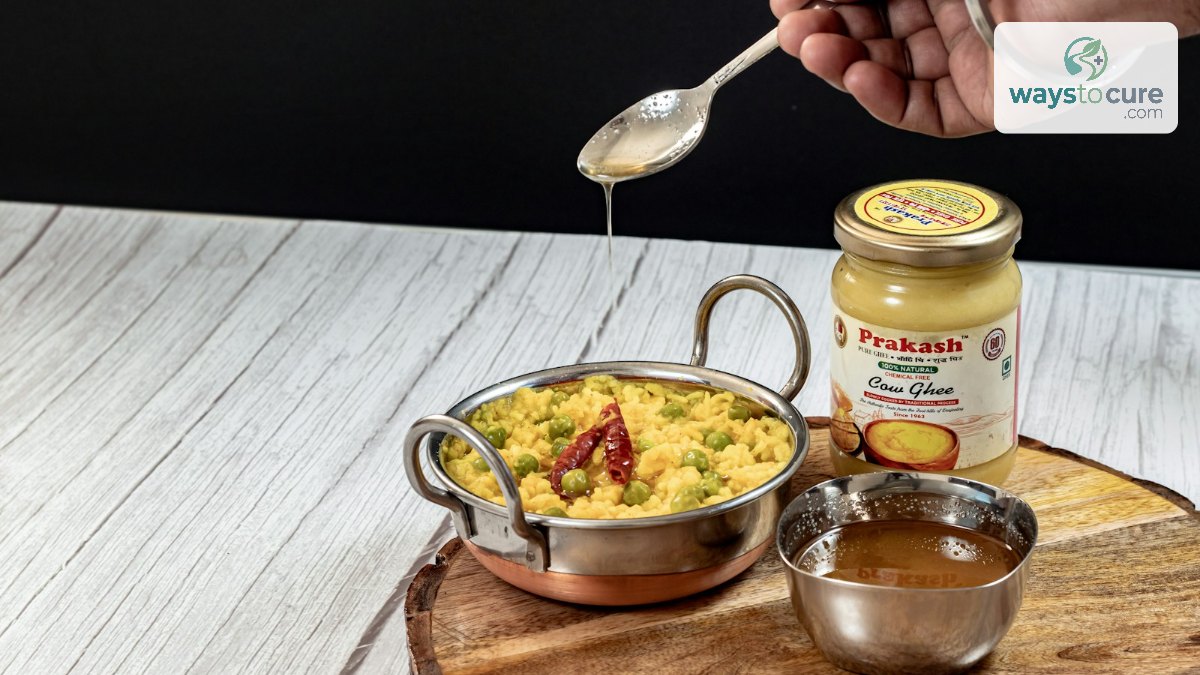
For most healthy adults, 1 to 2 teaspoons of ghee a day (roughly 5 to 10 g) fits comfortably into a balanced Indian diet, as long as it counts toward your total cooking fat for the day and isn’t added on top of it. If you have high LDL cholesterol, heart disease or you’re trying to lose weight, keep it nearer the lower end and get most of your cooking fat from vegetable oils.
Ghee isn’t poison and it isn’t medicine. It’s a concentrated fat, mostly saturated, and the amount matters far more than whether it’s desi, A2, bilona or homemade. Here’s what the numbers actually look like.
What is ghee made of?
Ghee is clarified butter: butter heated until the water evaporates and the milk solids are strained off. What’s left is almost pure fat. According to the USDA FoodData Central entry for anhydrous butter oil (ghee), 100 g contains:
- 99.5 g total fat
- 61.9 g saturated fat
- 28.7 g monounsaturated fat
- 3.7 g polyunsaturated fat
- 256 mg cholesterol
- 876 kcal
So about 62% of the fat in ghee is saturated. Compare that with groundnut, mustard, sunflower or soybean oil, where most of the fat is unsaturated. That one difference explains nearly all of the health debate around ghee.
How much is a teaspoon of ghee, in numbers?
USDA lists one tablespoon of ghee as 12.8 g, which makes a level teaspoon about 4.3 g. Using the figures above, this is what you’re eating:
| Amount of ghee | Weight | Calories | Saturated fat |
|---|---|---|---|
| ½ teaspoon (a light smear on one roti) | about 2 g | about 19 kcal | about 1.3 g |
| 1 teaspoon (on a bowl of dal or khichdi) | about 4.3 g | about 38 kcal | about 2.7 g |
| 2 teaspoons | about 8.5 g | about 75 kcal | about 5.3 g |
| 1 tablespoon (common in parathas or halwa) | 12.8 g | about 112 kcal | about 7.9 g |
These are level spoons. A heaped serving spoon from the ghee jar can easily be two or three times as much, which is where most people go wrong without noticing.
What ICMR-NIN and WHO say about daily fat
India’s National Institute of Nutrition doesn’t give a separate ghee allowance. Instead, it caps all visible fat together. In its 2020 note on nutrient requirements for Indians, ICMR-NIN says visible fat (cooking oil) should be limited to 20 to 50 g per person per day (4 to 10 teaspoons) depending on how many calories you need, and not more than 27 g a day for a 2,000 kcal diet. Ghee, butter and every oil you cook with all count toward that one number.
The WHO’s 2023 guideline on fats recommends keeping saturated fat to no more than 10% of your total energy, and it lists ghee alongside butter, lard, palm oil and coconut oil as hard fats that are high in saturated fat. On a 2,000 kcal day, 10% works out to about 22 g of saturated fat. The NHS gives similar practical limits: no more than 30 g a day for men and 20 g for women.
Put those together and a sensible split for an average adult on about 2,000 kcal looks like this: around 27 g of visible fat in total, of which 1 to 2 teaspoons is ghee and the rest is vegetable oil. Two teaspoons of ghee uses up about a quarter of your saturated fat budget, leaving room for milk, curd, paneer, nuts and the fat already hidden in biscuits, namkeen and restaurant food.
Is ghee bad for your heart? What the evidence shows
The honest answer is that the evidence on ghee itself is thin, while the evidence on saturated fat in general is much stronger.
Saturated fat and heart disease. A 2020 Cochrane review of 15 randomised trials with about 56,000 people found that cutting saturated fat for at least two years lowered the risk of combined cardiovascular events (heart attacks, strokes and similar) by about 17%. It made little or no difference to deaths. Swapping saturated fat for polyunsaturated fat or for carbohydrate looked useful. The NHS explains the mechanism simply: too much saturated fat can raise LDL (“bad”) cholesterol, while replacing some of it with unsaturated fat lowers it.
Ghee specifically. A 2025 meta-analysis in Progress in Nutrition pooled 10 studies with nearly 20,000 people, many from the Indian subcontinent. It reported a slightly higher risk of coronary heart disease with ghee (odds ratio 1.15), but the confidence interval crossed 1, which means the result wasn’t statistically firm. It found no clear effect on overall blood lipids. A small 2016 survey of 137 adults in Jodhpur found no significant difference in heart disease history between people who mainly used ghee and those who mainly used mustard oil, but it was cross-sectional and far too small to settle anything.
So there’s no good evidence that ghee “cleans arteries” or protects the heart, and no good evidence that a spoon a day is dangerous for a healthy person. What’s well supported is that a diet heavy in saturated fat from any source raises LDL, and that people who cut back tend to have fewer heart events.
Who should be more careful with ghee?
- People with high LDL cholesterol. If your lipid report shows LDL above the target your doctor has set, saturated fat is one of the first things to trim. Half a teaspoon on dal, rather than a tablespoon in every meal, is a realistic change.
- People with heart disease, a stent, bypass surgery or a stroke. Follow your cardiologist’s or dietitian’s advice on total fat. Many will suggest keeping ghee for occasional use.
- Anyone trying to lose weight. At about 38 kcal per teaspoon, ghee adds up quickly. Three generous tablespoons across a day (parathas, a ghee-laden dal and a sweet) can add over 300 kcal.
- People with diabetes. Diabetes already raises heart risk, so the same saturated fat limits apply.
- People following very high-fat diets. Bulletproof coffee with ghee and keto-style plans can push saturated fat well beyond 10% of energy. If you’re on one, ask for a lipid test after a few months. Our beginner’s guide to the keto diet covers what to watch.
Ghee vs cooking oils: which should you use?
Using a mix works better than picking a single “winner”. A practical approach for an Indian kitchen:
- Use a vegetable oil such as mustard, groundnut, rice bran, sunflower or soybean oil for most everyday cooking: sabzi, dal tadka, poha, upma.
- Rotate between two or three oils over the month rather than sticking to one, so you get a spread of fatty acids.
- Keep ghee for where you’ll taste it: a teaspoon over dal-chawal, khichdi or a festive sweet.
- Measure your monthly oil. For a family of four eating about 27 g visible fat each, that’s roughly 3.2 kg of oil and ghee together in a month. If your household goes through much more than that, there’s room to cut.
- Don’t use vanaspati or other hydrogenated fats. The WHO says trans fat should be no more than 1% of your energy, and partially hydrogenated fats are a common source.
Coconut oil and palm oil sit closer to ghee than to groundnut or mustard oil, since WHO groups them with the hard, saturated fats. Swapping ghee for coconut oil doesn’t solve much.
Smoke point myths about ghee
You’ll often hear that ghee is “safer” for frying because of its high smoke point. Ghee does handle heat well, partly because saturated fat is stable when heated. But smoke point only tells you when a fat starts to break down in the pan. It tells you nothing about what that fat does to your cholesterol once you’ve eaten it.
The bigger kitchen problem is reusing the same oil or ghee again and again for pakoras, puris and samosas. Reheated fat breaks down further each time. Use fresh fat for deep frying, keep deep-fried food occasional, and throw away fat that has turned dark, thick or smoky.
Other claims you’ll see online, such as ghee “melting belly fat”, “lubricating joints” or “detoxing the gut”, aren’t backed by good human studies. Enjoy it for flavour, not as a supplement.
When to see a doctor
Diet changes alone aren’t enough if you have warning signs. Get medical advice if:
- You’re over 30 and have never had a lipid profile, or it’s been more than a few years since your last one.
- Your LDL, triglycerides or total cholesterol are flagged as high on a report.
- You have a family history of heart attack at a young age, such as a parent or sibling who had one in their 40s or early 50s.
- You have diabetes, high blood pressure or kidney disease. Winter can push readings up, as we explain in why blood pressure rises in winter.
Call 112 straight away for chest pain or pressure lasting more than a few minutes, pain spreading to the arm, jaw or back, breathlessness, sweating or nausea. Don’t wait to see if it’s gas; our guide on telling gas pain from a heart attack explains why.
Frequently asked questions
Is 1 tablespoon of ghee a day too much?
For many adults it’s on the high side. One tablespoon (12.8 g) gives about 8 g of saturated fat, over a third of a 22 g daily limit on a 2,000 kcal diet, before you count milk, paneer or packaged snacks. One to two teaspoons is an easier fit.
Is ghee healthier than refined oil?
Not for your cholesterol. Most vegetable oils are mainly unsaturated fat, and swapping saturated fat for unsaturated fat lowers LDL. Ghee’s advantage is flavour, and you need less of it to enjoy it. Using both, with oil as the main cooking fat, is a reasonable approach.
Does ghee help with weight loss?
There’s no good evidence that it does. It’s about 38 kcal a teaspoon, so it adds calories. If you’re trying to lose weight, measure it with a teaspoon rather than pouring from the jar. Our guide to losing weight safely has more practical tips.
Is homemade or A2 ghee better for the heart?
There’s no reliable evidence that homemade, bilona or A2 ghee affects cholesterol differently. All ghee is mostly saturated fat, so the same daily amounts apply.
Can children eat ghee?
Yes, small amounts are fine in a varied diet. The WHO’s 10% saturated fat limit applies from age 2 onwards, so keep children’s portions in proportion to their smaller calorie needs.
This article is for general information and is not a substitute for advice from a doctor. If you have symptoms or a health condition, please consult a qualified healthcare professional.