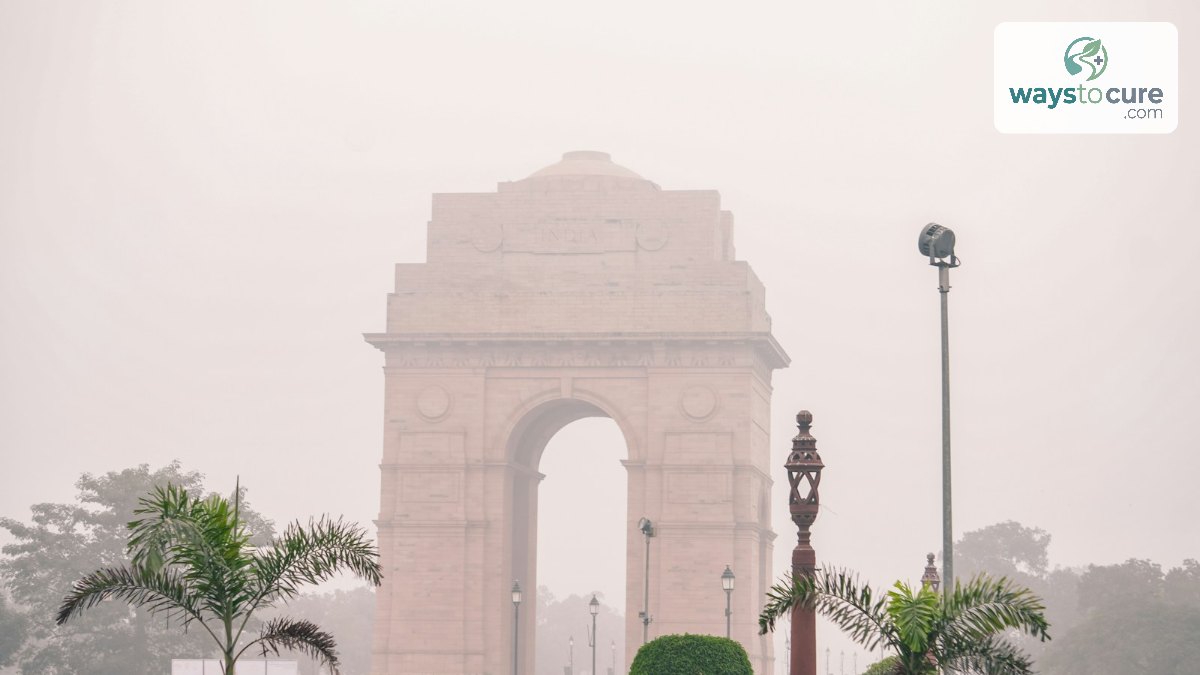
Air quality usually hits its worst point in the hours after Diwali night, because fireworks smoke is released into cold, still air that can’t carry it away. The firework spike itself typically fades over a day or two once the wind picks up, but in Delhi and much of north India the air often stays “poor” or worse for weeks, because crop-stubble smoke and winter weather keep the background level high.
So if your city woke up to a grey, smoky morning today, assume the next two to three days need care, especially for children, older adults and anyone with asthma, COPD or heart disease.
How bad does the air get after Diwali?
In Delhi, very bad. A Climate Trends analysis of Central Pollution Control Board (CPCB) data, reported by PTI, compared the average PM2.5 level (fine particles, in micrograms per cubic metre) in the 24 hours before and after Diwali for the last five years:
| Diwali | PM2.5 before Diwali (µg/m³) | PM2.5 after Diwali (µg/m³) |
|---|---|---|
| 2021 (4 Nov) | 163.1 | 454.5 |
| 2022 (24 Oct) | 129.3 | 168 |
| 2023 (12 Nov) | 92.9 | 319.7 |
| 2024 (31 Oct) | 204 | 220 |
| 2025 (20 Oct) | 156.6 | 488 |
Two things stand out. Last year’s post-Diwali level was the highest of the five. And the jump varies wildly from year to year: in 2024 the air was already bad before Diwali and barely changed, while in 2023 it more than tripled.
Other cities see the same pattern. A study in Lucknow during Diwali 2020 measured PM2.5 at about 352 µg/m³ on Diwali night, against roughly 101 the night before. A 2026 study of 14 cities across the Indo-Gangetic plain found particle levels during Diwali at 3 to 10 times the applicable standards, with 80% of the cities moving into “severe” or “hazardous” health-index categories.
Why the air is worst overnight
Three things pile up on the same night.
Fireworks start after dark. A PLOS ONE analysis of hourly Delhi data from 2013 to 2017 found PM2.5 didn’t rise before 6 pm on Diwali, then climbed by up to about 100% within around five hours. That puts the peak late at night and into the early morning.
Cold, calm air traps the smoke. On clear autumn nights the ground cools fast, and a layer of warmer air can sit on top of the cooler air near the ground like a lid (a temperature inversion). With little wind, smoke stays at breathing height. The 14-city study above names low wind, temperature inversions and high humidity as the conditions that trapped pollutants, and the Climate Trends analysis linked last year’s spike to winds below 1 metre per second and an inversion.
Weather can matter as much as the fireworks themselves. Researchers from the SAFAR network at the Indian Institute of Tropical Meteorology compared two Delhi Diwalis: the peak 24-hour PM2.5 was 1,620 µg/m³ in 2010 but 390 µg/m³ in 2011, and they put the large difference down to the weather.
Stubble smoke adds to the base level. Diwali falls in the crop-burning season in Punjab and Haryana. An IITM modelling study of 2021 estimated that farm fires contributed up to about 30 to 35% of Delhi’s daily PM2.5 at their peak in October and November. Interestingly, that share was highest from late morning to afternoon and lowest from evening to early morning, which suggests the overnight spike is mostly local smoke, from crackers, sitting in still air.
The PLOS ONE authors made another useful point: Delhi’s background pollution around Diwali is already so high that firecrackers add a “small, but statistically significant” amount on top. That doesn’t make crackers harmless. It means today’s bad air is a mix of sources, and it won’t vanish the moment the last rocket goes up.
What is actually in firecracker smoke?
It’s more than ordinary smoke. A review in Lung India lists what fireworks release:
- Fine particles (PM2.5 and PM10), which reach deep into the lungs
- Gases including sulphur dioxide, nitrogen oxides and carbon monoxide
- Metals such as aluminium, barium, copper, strontium, antimony, lead, magnesium and potassium
Many of the metals are there on purpose. Compounds such as strontium and barium nitrate act as oxidisers and give fireworks their colours, and the mix varies from one product to another.
The Lucknow study measured 17 elements in Diwali-night PM2.5. Potassium was the most abundant, followed by barium, aluminium and zinc, with smaller amounts of lead, strontium, copper, nickel, chromium, arsenic and cadmium. Sulphur dioxide and nitrogen dioxide also rose sharply that night.
How long does it take to clear?
There are two answers, and both matter.
The firework spike: usually a day or two. In Lucknow, PM2.5 the night after Diwali was back to about 96 µg/m³, close to the pre-Diwali level. In the Delhi data, the daily pattern showed pollution rising from two days before Diwali to two days after it. The 14-city study found that Chandigarh recovered quickly after the festival.
The background haze: often weeks. The same 14-city study found that most other cities stayed polluted, because farm burning and continued cracker use dragged the episode out. In Delhi, stubble smoke keeps contributing through October and November, and calm winter nights keep trapping whatever is in the air.
What speeds things up is wind, and to a lesser extent rain. What slows it down is more of the same: still nights, fog, more crackers at weddings and other celebrations, and burning of leaves and rubbish. Watch your local AQI on CPCB’s Sameer app rather than guessing.
Who should take extra care today?
Everyone breathes this air, but some people feel it sooner and harder:
- People with asthma or COPD. The Lung India review cites reports from India of a 30 to 40% rise in wheezing and asthma attacks during Diwali, though it notes formal studies are limited.
- People with heart disease. An American Heart Association scientific statement says exposure to PM2.5 over a few hours to weeks can trigger heart-related deaths and non-fatal events such as heart attacks.
- Children. Our guide to pollution, asthma and warning signs in children covers what to watch for.
- Older adults, pregnant women, and people with diabetes.
What to do in the next 48 to 72 hours
A short checklist for the days after Diwali:
- Check the live AQI before going out. Our article on what to do when AQI is above 300 explains the CPCB bands and when to air out the house.
- Move walks and workouts indoors today and tomorrow, or wait until the reading drops. Skip anything that makes you breathe hard outside.
- Keep windows shut while the reading is high, then open up briefly when it improves.
- Wear a well-fitting N95 or FFP2 mask if you must be outside. Our explainer on whether N95 masks work against pollution covers fit and which masks don’t help.
- Run an air purifier in the bedroom if you have one. Our air purifier buying guide explains CADR and room size.
- Don’t add to it. Skip leftover crackers, and don’t burn leaves, rubbish or cracker waste. Sweep up debris with a damp cloth or mop rather than a dry broom.
- Check medicines. If someone at home uses a reliever inhaler, make sure it isn’t empty and they know their action plan.
- Look in on older neighbours and relatives, especially those who live alone.
If anyone’s eyes are still red or painful after last night’s fireworks, that may be more than smoke irritation; see our guide to firecracker eye injuries.
When to see a doctor
A scratchy throat, watery eyes and a mild dry cough are common on a morning like this. These are not, and need emergency help (call 112):
- Severe breathlessness, gasping, or being unable to finish a sentence
- Chest pain, pressure or tightness, especially if it spreads to the arm, jaw or back
- Lips or face turning blue or grey
- Sudden confusion or unusual drowsiness
- An asthma attack that isn’t easing with the reliever inhaler
See a doctor the same day if breathlessness or wheezing is worse than usual for you, you need your reliever inhaler more often than normal, a cough comes with fever, or you notice palpitations.
Frequently asked questions
Why is the air worse the morning after Diwali than on Diwali evening?
Most fireworks go off after 6 pm, and smoke keeps building for several hours. Cold, calm night air holds it close to the ground, so levels are often highest late at night and early the next morning.
How many days does post-Diwali pollution last?
The extra smoke from crackers usually fades in a day or two if the wind picks up. In north India, though, background pollution from farm fires and winter weather can keep the air poor for weeks.
Is firecracker smoke more harmful than normal smog?
It contains the same fine particles and gases, plus metals such as barium, strontium, potassium and lead. Several of these are added on purpose to give fireworks their colours, and a Lucknow study found them in Diwali-night air samples.
Is stubble burning or fireworks the bigger cause?
Both contribute, and weather decides how bad it gets. An IITM study put farm fires at up to 30 to 35% of Delhi’s daily PM2.5 at their peak, while the overnight Diwali spike looks largely like local smoke trapped in still air.
Is it safe to go for a morning walk the day after Diwali?
Not if the AQI is “very poor” or “severe”. Walk indoors, or check the live reading and wait until it drops. Don’t assume early morning is the cleanest time; after Diwali it’s often the worst.
This article is for general information and is not a substitute for advice from a doctor. If you have symptoms or a health condition, please consult a qualified healthcare professional.