
For decades, Kegel exercises have been a commonly prescribed, yet often misunderstood, practice for strengthening the pelvic floor. Many people hear the term and immediately associate it with stopping the flow of urine—a common, but fundamentally incomplete, way to explain the movement. The reality is that correctly performed Kegel exercises, also known as pelvic floor muscle training (PFMT), are a foundational component of pelvic health, impacting everything from bladder and bowel control to core stability, back pain, and sexual function.
This article is designed to be the comprehensive, people-first guide you will bookmark. It moves far beyond the simple instruction, “Squeeze as if you’re holding urine,” to provide you with the exact, biomechanical steps necessary to identify, isolate, train, and progress your pelvic floor muscles (PFMs) safely and effectively. We will address the ‘why,’ the ‘how,’ the ‘when,’ and the critical ‘what-not-to-do’ that can make or break your success.


The expertise presented here is drawn from years of synthesizing clinical physical therapy knowledge, ensuring you have the authoritative and trustworthy information required to take control of your pelvic health journey. This is not about a quick fix; it’s about mastering a subtle, yet powerful, set of muscles for lifelong well-being.
Table of Contents
The Anatomy of Mastery – Understanding Your Pelvic Floor
Before you can correctly train a muscle, you must first understand what it is and where it is located. The lack of this foundational understanding is the single greatest reason why people perform Kegels incorrectly.
1. What is the Pelvic Floor?
Imagine a hammock or a trampoline stretching from your pubic bone at the front to your tailbone (coccyx) at the back, and across to your sitting bones (ischial tuberosities) on the sides. This is your pelvic floor. It is a complex group of muscles, ligaments, and fascia that serves three crucial roles:
- Support: It holds your pelvic organs (bladder, uterus/prostate, and rectum) in place against the relentless force of gravity and intra-abdominal pressure.
- Sphincteric Control: It wraps around the urethra and rectum, providing the necessary ‘closing’ pressure to maintain continence (prevent leaks) and the ability to ‘open’ to allow urination or bowel movements.
- Sexual Function: It plays a vital role in sensation, arousal, and orgasm.
2. The Difference Between Kegels and Core Engagement
A critical misconception is that Kegels are simply clenching your glutes or tightening your abdomen. They are not.
- Kegel Exercise: This is the lifting and squeezing of the muscles inside the base of your pelvis. It is an internal, upward movement.
- Abdominal Muscles (Core): These muscles, particularly the transverse abdominis, work in concert with the pelvic floor, but they are separate. Engaging the core without the pelvic floor is incomplete; recruiting the pelvic floor without over-engaging the core is a sign of proper isolation.
Expert Insight: Over-recruiting surrounding muscles (glutes, inner thighs, abdominals) is the most common error. If you find yourself holding your breath or tensing your buttocks, you are not performing the Kegel correctly.

The Essential First Step – How to Find and Isolate the Correct Muscles
You cannot strengthen what you cannot find. Isolation is the cornerstone of correct Kegel performance. This is where we move beyond vague descriptions to concrete, tactile awareness.
3. The Sensory Identification Technique (The “Lift”)
The objective here is to feel the upward lift of the pelvic floor, not just a squeeze.
Positioning and Relaxation:
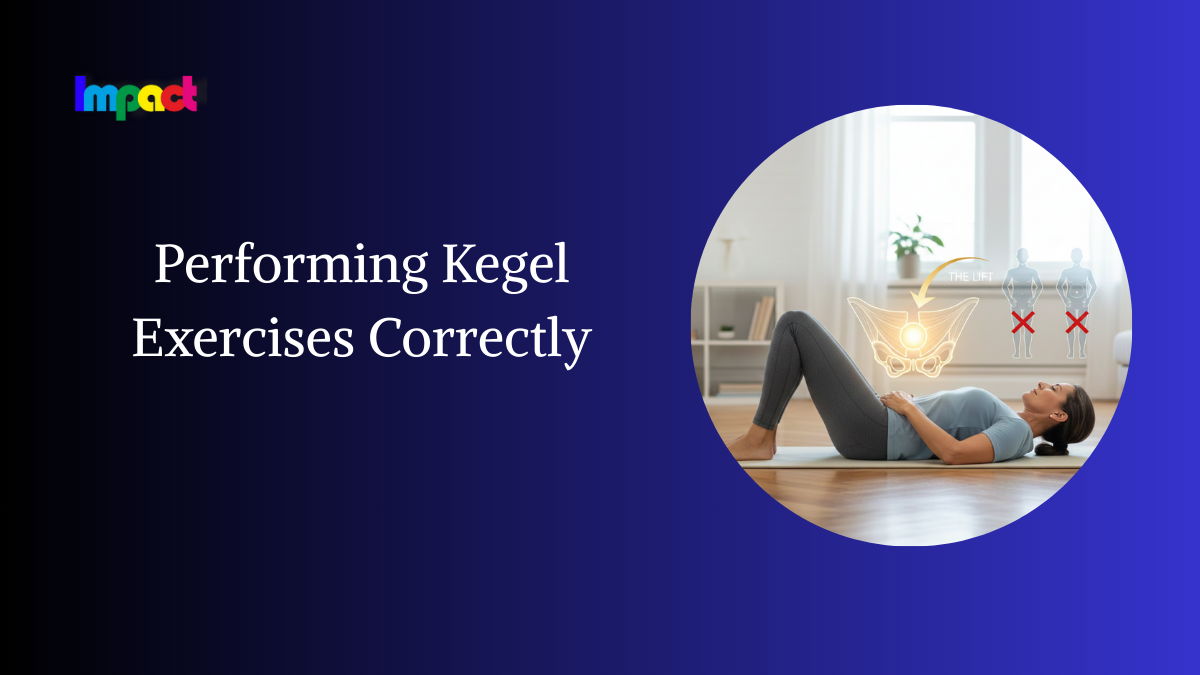
Lie down comfortably on your back with your knees bent and feet flat on the floor, about hip-width apart. This position minimizes the pull of gravity and relaxes the abdominal muscles. Close your eyes and take a few deep, mindful breaths, focusing on relaxing your entire body, especially your jaw, glutes, and inner thighs.
The ‘Holding Back Wind’ Analogy:
Focus your attention on the anal sphincter. Without squeezing your glutes, gently and subtly try to draw your tailbone up toward your pubic bone, as if you are trying to prevent passing gas. This is a contraction of the posterior (back) part of the pelvic floor.
The ‘Stopping Urine’ Analogy (Use With Caution):
Now, shift your focus to the front, the muscles around the urethra. Gently and subtly try to pull the muscles up and in, as if you are trying to stop the flow of urine midstream.
CRITICAL WARNING: While this technique helps for identification, it should never be used as a routine exercise. Repeatedly stopping the flow of urine can disrupt the normal coordination of the bladder, potentially leading to incomplete emptying or even infection. Use this only once or twice for identification, then rely on the feeling.
The Combined Lift: The Correct Contraction:
The true, correct Kegel is a combination of the two: a gentle, concerted effort to lift and draw in the entire pelvic floor area, from front to back, up towards the inside of your belly button. Think of it like an internal elevator moving smoothly up to the first floor.
The Test: Place a clean finger lightly on your perineum (the area between the vagina and the anus for women, or the scrotum and the anus for men). When you perform the lift correctly, you should feel a subtle tension and lift under your finger. If you feel a downward push, you are bearing down, which is incorrect and harmful.
4. Avoiding Contamination: The Wrong Muscles
If you feel any of the following during your Kegel attempt, you are using the wrong muscles:
- Glutes Clenching: The buttocks should remain soft and relaxed.
- Inner Thighs Tightening: Your adductor muscles are not the target.
- Abdominal Bearing Down: Your tummy should not push outward or forcefully brace. A very gentle tension in the lower abdomen is acceptable, but the primary movement must be the internal lift.
- Holding Your Breath (The Valsalva Maneuver): You must be able to breathe normally and rhythmically throughout the exercise. Holding your breath increases intra-abdominal pressure, which can counteract the lifting force of the pelvic floor.
The Mechanics of Correct Kegel Performance
Once isolation is confirmed, you can begin the formal training. Kegel exercises are not a monolithic activity; they involve two primary types of contractions necessary for functional strength and endurance.
5. Type 1: The Slow-Twitch (Endurance) Hold
The slow-twitch muscle fibers provide the sustained support needed for everyday activities like standing, carrying groceries, or walking—the constant, low-level tone that prevents leakage during normal activity.
The Step-by-Step Method:
- Preparation: Assume the comfortable supine position (on your back, knees bent) or a seated position with good posture.
- The Lift: Inhale deeply, then as you exhale, gently initiate the pelvic floor contraction. LIFT the muscles up and in to about 50-70% of your maximum effort. Avoid a maximal, straining clench.
- The Hold: MAINTAIN this smooth, gentle lift for a target duration of 5 to 10 seconds. Crucially, you must continue to breathe normally (small, even breaths) while holding the contraction. The goal is to feel the effort of the hold without the tension spreading to your face, neck, or glutes.
- The Release: After the hold, SLOWLY and COMPLETELY release the muscles. The release is just as important as the contraction. You should feel a distinct sensation of the muscles dropping back to their resting position. This rest phase allows blood flow and prevents muscle fatigue or hypertonicity (over-tightening).
- The Rest: Rest for at least the same amount of time as the hold (e.g., a 10-second hold requires a 10-second rest).
Progression for Endurance:
Begin with 5-second holds and aim for 10 repetitions. As you get stronger, gradually increase the hold time until you can comfortably and correctly hold for a full 10 seconds, maintaining a total of 10 repetitions.
6. Type 2: The Fast-Twitch (Power) Flick
The fast-twitch muscle fibers are responsible for the quick, powerful contractions needed to prevent leakage during sudden increases in intra-abdominal pressure—such as coughing, sneezing, laughing, jumping, or lifting heavy objects.
The Step-by-Step Method:
- Preparation: Maintain the same relaxed, supported position.
- The Quick Lift: Initiate the pelvic floor contraction with a QUICK, forceful, and maximal lift (up to 80-90% effort). This is a “flick” or a “pulse.”
- The Immediate Release: Without trying to sustain the effort, IMMEDIATELY and COMPLETELY release the contraction. The entire movement—contraction and relaxation—should take no more than 1 to 2 seconds.
- The Rest: Rest for 3 to 5 seconds between each flick to ensure a full recovery.
Progression for Power:
Aim for 10-15 quick flick repetitions. The quality of the release is paramount. Ensure you are not holding residual tension between each repetition.
Integration and Progression – Making Kegels Functional
7. The Recommended Training Protocol
Consistency is the key to strengthening this muscle group, just as it is with any other.
| Type of Exercise | Repetitions | Hold Time | Rest Time | Frequency |
| Endurance Holds (Slow) | 10 | 5 to 10 seconds | Equal to Hold Time | 3 Times Per Day |
| Power Flicks (Fast) | 10 to 15 | 1 second | 3 to 5 seconds | 3 Times Per Day |
Total Daily Commitment: Aim to complete a full set of both slow and fast Kegels, three times per day (morning, afternoon, and evening). This protocol aligns with the standards often recommended by pelvic health physical therapists.
8. Functional Integration: The “Knack” Technique
This technique is the difference between doing Kegels in isolation and applying them in real-time. It’s often called The Knack.
- What it is: The conscious pre-contraction of the pelvic floor muscles immediately before or during an action that increases intra-abdominal pressure.
- When to use it: Before you cough, sneeze, laugh, lift something heavy, stand up quickly, or jump.
- How to do it: Just milliseconds before the expected ‘force’ hits, perform a quick, maximal Power Flick (Type 2 Kegel). This pre-emptive squeeze effectively supports the bladder and organs against the sudden downward force, preventing leakage.
Real-Life Application Example: If you feel a sneeze coming on, perform the quick, upward lift just as the sneeze begins. Over time, your body will begin to automate this protective response.
9. Varying Positions for Advanced Training
While starting in a reclined position is best for isolation, you need to train the muscles to work against gravity.
- Seated: Perform your holds and flicks while sitting upright on a firm chair. Focus on feeling the muscles lift up away from the seat.
- Standing: This is the most challenging position, as the muscles are working against full gravity. Integrate this once you are confident in your seated and reclined form. Practice the power flicks while standing, such as right before you bend over to pick something up.
- During Exercise: Incorporate the endurance holds during a core or stabilization exercise (e.g., holding the lift gently while performing a simple bridge or during a plank).
Common Pitfalls, When to Stop, and Seeking Professional Help
Knowing what to avoid is as crucial as knowing what to do. The goal is to strengthen, not to cause pain or hypertonicity.
10. The Critical Mistake: Bearing Down (The Reverse Kegel)
The absolute worst way to perform a Kegel is to push down or bear down, similar to the effort used during a bowel movement.
- Effect: This downward pressure weakens the pelvic floor, strains the ligaments, and can lead to or worsen pelvic organ prolapse, hemorrhoids, and urinary incontinence.
- Correction: If you feel a pushing sensation, stop immediately. Revert to the lying down position, focus intensely on the upward lift described in Part II, and reduce your effort level to a very gentle 20-30% contraction until you can feel the correct direction of movement.
11. Over-Training and Hypertonicity
More is not always better. A common issue is over-training, leading to a condition called hypertonicity or pelvic floor muscle tension.
- Symptoms of Hypertonicity: Chronic pelvic pain, painful intercourse (dyspareunia), difficulty initiating urination, or constipation. The muscles are constantly in a semi-contracted, tight state and cannot function optimally.
- When to Stop or Seek Help: If you experience any of these symptoms, STOP your Kegel routine. Your focus must shift to pelvic floor relaxation and stretching before attempting strengthening again.
12. Understanding Failure and Seeking Expert Guidance
Kegel exercises are not a panacea, and they are not right for everyone.
| Scenario | Possible Cause and Action |
| You cannot feel the muscles at all. | Cause: Poor mind-body connection or significant nerve injury. Action: Seek a Pelvic Health Physical Therapist (PHPT) who can use biofeedback or real-time ultrasound to help you identify and visualize the muscles. |
| You are leaking despite consistent training. | Cause: Weakness is too advanced for Kegels alone, coordination issues, or an underlying condition. Action: A PHPT can assess the strength (using a manometer or digital assessment) and coordination to prescribe a targeted, effective program. |
| You have chronic pelvic pain. | Cause: Possible hypertonicity or a non-muscular source of pain. Action: Kegels may make this worse. A PHPT is essential for diagnosis and a relaxation-based treatment plan. |
A Pelvic Health Physical Therapist is the gold standard for diagnosis and treatment. They can provide personalized instruction, ensuring you are performing the exercises with perfect form and for the correct reasons.
Lifestyle Factors – Supporting Your Pelvic Floor
Training is only one part of the equation. Your daily habits and lifestyle significantly impact the health and function of your pelvic floor.
13. Managing Intra-Abdominal Pressure
Everything that puts strain on your core places a downward force on your pelvic floor. Managing this pressure is critical for protection.
- Chronic Coughing: Treat the cause of the cough (allergies, asthma, smoking) to reduce constant, damaging pressure.
- Constipation: Straining during bowel movements is a major cause of pelvic floor damage. Ensure your diet is rich in fiber, you are adequately hydrated, and you use a squatty potty or footstool to optimize colon alignment and reduce straining.
- Heavy Lifting: When lifting, always use the Knack Technique—contract your pelvic floor and core before you lift—and lift with your legs, not your back.
- High-Impact Exercise: High-impact activities (running, jumping, intense aerobics) are fine, but if they cause leakage, they are too much for your current pelvic floor strength. Gradually build strength before returning to high-impact work, always integrating the Knack.
14. Posture and Body Alignment
Your posture directly affects the resting length and function of your pelvic floor.
- Slouching: When you slouch, the abdominal contents push forward, placing strain on the pelvic ligaments and inhibiting the pelvic floor muscles from contracting effectively.
- Ideal Seated Posture: Sit tall on your sit bones (ischial tuberosities), maintaining a gentle curve in your lower back, and keep your ribs stacked over your pelvis. This allows the pelvic floor muscles to rest at their optimal length, ready to contract efficiently.
15. The Importance of Hydration and Diet
- Hydration: Many people restrict fluid intake to avoid leaks, but this makes urine more concentrated, which can irritate the bladder lining and paradoxically increase urgency and frequency. Drink plenty of water throughout the day.
- Bladder Irritants: For those with urgency/frequency, consider temporarily reducing or eliminating common bladder irritants like caffeine, alcohol, acidic foods (tomatoes, citrus), and artificial sweeteners to see if symptoms improve.
Conclusion: The Path to a Stronger Foundation
Correctly performing Kegel exercises is a skill that requires patience, consistency, and above all, mindful isolation. It is not about how hard you clench, but how effectively you lift and release.
By following this definitive, step-by-step guide—moving from anatomical understanding to precise isolation, mastering the slow and fast twitch contractions, integrating the Knack into your daily life, and addressing lifestyle factors—you are empowering yourself with the tools for lifelong pelvic health.
Remember: the goal is to build a functional foundation that supports your body through every sneeze, laugh, and heavy lift. If at any point you struggle with identification, experience pain, or do not see results after 8-12 weeks of consistent, correct practice, do not hesitate to consult a Pelvic Health Physical Therapist. They are your expert partners in this journey. Your pelvic health is vital; treat these muscles with the respect and dedication they deserve.