To do CPR on an adult, call your local emergency number, then push hard and fast in the centre of their chest: about 5 to 6 cm (2 to 2.4 inches) deep, at 100 to 120 pushes a minute, without stopping until help arrives or a defibrillator tells you to pause. If you haven’t been trained in rescue breaths, chest compressions alone are fine and still give the person a real chance.
That’s the whole idea. The steps below fill in the details, so you know exactly what to do in the first few minutes, when it matters most.
When CPR is needed
CPR (cardiopulmonary resuscitation) is for someone whose heart has stopped pumping properly, known as cardiac arrest. You’ll see two things together:
- they don’t respond when you shake their shoulders and speak loudly to them
- they aren’t breathing normally
Watch out for slow, noisy or irregular gasps. They’re common in the first minutes of cardiac arrest and can fool people into thinking the person is breathing. St John Ambulance advises treating those occasional gasps as not breathing normally.
A heart attack is different. Someone having a heart attack is usually awake and talking, often with chest pain, and doesn’t need CPR unless they collapse. Our guide on telling gas pain from a heart attack covers those warning signs.
What you need
- A phone, ideally on speaker so your hands are free
- A firm, flat surface (the floor is best; a soft bed won’t work)
- A defibrillator (AED) if one is nearby. Many offices, gyms, stations and shopping centres have one
- Another person, if anyone is around, to call for help and fetch the AED
That’s it. You don’t need any equipment to start, and you don’t need permission.
How to do CPR on an adult: step by step
- Check it’s safe. Look for traffic, electricity, fire or anything else that could hurt you. You can’t help if you become a second casualty.
- Check for a response. Tap or gently shake their shoulders and ask loudly, “Are you all right?”
- Call for help. If there’s no response, shout for anyone nearby. Call your local emergency number (911 in the US, 999 in the UK, 112 in the EU and India) and put the phone on speaker. The call handler will coach you through what to do.
- Send for an AED. Ask a helper to find one. If you’re alone, don’t leave the person to look for it unless you know exactly where one is close by.
- Check breathing. Tilt their head back gently and lift the chin. Look, listen and feel for normal breathing for no more than 10 seconds.
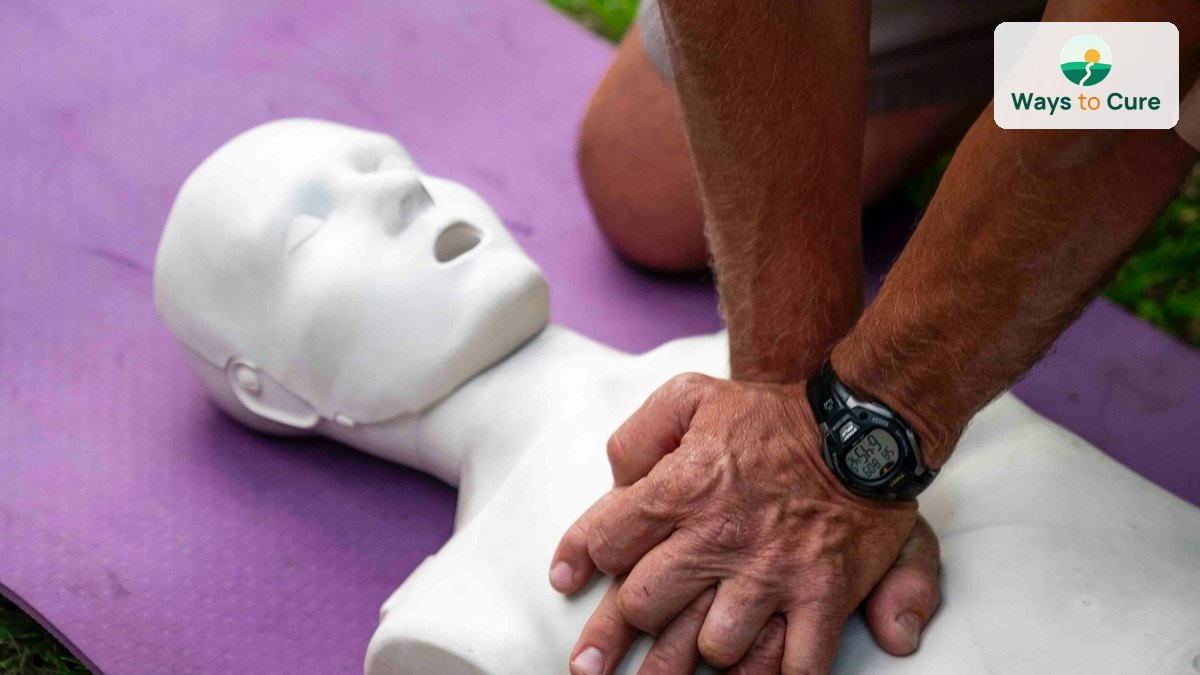
- Position your hands. Kneel beside them. Put the heel of one hand in the centre of the chest, on the lower half of the breastbone, and place your other hand on top. Lock your fingers together.
- Push hard and fast. With your arms straight and your shoulders directly above your hands, press down 5 to 6 cm (2 to 2.4 inches), then let the chest come all the way back up. Aim for 100 to 120 compressions a minute, about two per second. The beat of “Stayin’ Alive” by the Bee Gees is a good guide, as the British Heart Foundation suggests.
- Add rescue breaths only if you’re trained and willing. After 30 compressions, open the airway, pinch the nose, seal your mouth over theirs and give 2 breaths, each lasting about a second, watching the chest rise. Then go straight back to compressions. If you’re not trained, keep doing continuous compressions instead.
- Use the AED as soon as it arrives. Switch it on and follow the voice prompts. Keep compressions going while someone else attaches the pads.
- Keep going. Don’t stop until paramedics take over, the person starts breathing normally or shows clear signs of life, or you’re physically unable to continue. If there are two of you, swap every 1 to 2 minutes so compressions stay strong.
Using a defibrillator (AED)
An AED is designed for people with no training. It talks you through each step and only delivers a shock if it detects a heart rhythm that needs one. According to St John Ambulance’s AED guide:
- Turn it on and follow the prompts.
- Remove or cut clothing from the chest and wipe it dry if wet.
- Stick one pad below the right collarbone and the other on the left side of the chest, below the armpit. The pads have pictures showing where they go.
- When the machine analyses the heart rhythm, stop CPR and make sure nobody is touching the person.
- If it advises a shock, make sure everyone is clear and press the button when told (some machines shock automatically).
- Restart CPR straight away after the shock, or if no shock is advised, and keep following the prompts.
Giving CPR and using a defibrillator can double a person’s chance of survival, according to the British Heart Foundation.
Quick reference: adult CPR numbers
| What | Target |
|---|---|
| Hand position | Heel of hand, centre of chest, other hand on top |
| Depth | 5 to 6 cm (2 to 2.4 inches) |
| Speed | 100 to 120 compressions per minute |
| Ratio with breaths | 30 compressions, then 2 breaths (trained rescuers) |
| Without breaths | Continuous compressions, no pauses |
| Breathing check | No more than 10 seconds |
| Swap rescuers | Every 1 to 2 minutes |
Common mistakes
- Pushing too gently. Most people are afraid of hurting the person. Shallow compressions don’t move enough blood. You may hear or feel ribs crack. That’s distressing but it’s not a reason to stop.
- Leaning on the chest between pushes. Let the chest rise fully each time so the heart can refill.
- Going too fast or too slow. Use a song with the right tempo, or count aloud.
- Stopping too often. Every pause drops blood flow. Keep breaks for breaths short, under 10 seconds.
- Doing CPR on a soft surface. A mattress absorbs the force. Move the person to the floor if you can do it quickly.
- Starting CPR on someone who is breathing normally. MedlinePlus advises against compressions if the person is breathing normally, coughing or moving. Put them in the recovery position instead and keep watching their breathing.
- Checking for a pulse. Unless you’re a healthcare professional, skip it. It wastes time and is easy to get wrong.
When to get professional help
Always. CPR keeps blood flowing to the brain, but the person needs paramedics and hospital care. Call emergency services before or as you start CPR, not after.
Even if the person wakes up or starts breathing on their own, they still need to go to hospital. Stay with them in the recovery position, keep the AED pads on if used, and be ready to start again if they stop breathing normally.
The best preparation is a short, hands-on course. Organisations like the Red Cross, St John Ambulance and the American Heart Association run them, often in a couple of hours, and practising on a manikin makes the depth and speed feel natural. Knowing the signs of a stroke helps too, and our BE FAST stroke guide explains what to do in the first hour.
Frequently asked questions
Is hands-only CPR as good as CPR with breaths?
For an adult who suddenly collapses, compression-only CPR is what most bystanders are advised to do, and it’s far better than doing nothing. If you’re trained and willing, adding breaths at 30:2 is also fine.
Can I get in legal trouble for doing CPR?
Many countries, including the US and UK, have laws or legal principles that protect people who help in good faith in an emergency. The bigger risk to the person is that nobody tries.
What if I break their ribs?
It can happen, especially in older people. A broken rib can heal. Cardiac arrest without CPR is usually fatal, so keep going.
How long should I keep doing CPR?
Until emergency services take over, an AED tells you to stop, the person starts breathing normally, or you’re too exhausted to continue.
Is CPR different for children and babies?
Yes. Children and babies need gentler compressions and rescue breaths matter more, because their cardiac arrests are often caused by breathing problems. Take a paediatric first aid course if you look after young children.
Cold weather puts extra strain on the heart, which is why blood pressure often rises in winter. It’s a good season to learn CPR.
This article is for general information and is not a substitute for advice from a doctor. If you have symptoms or a health condition, please consult a qualified healthcare professional.