A slipped disc usually gets better on its own: Cleveland Clinic says about 9 in 10 people improve without surgery, and many feel much better within four to six weeks. What helps most in the meantime is staying gently active, using painkillers sensibly and getting physiotherapy if pain lingers, while watching for a short list of emergency signs that need hospital care the same day.
This guide explains what’s actually happening in your back, what you can safely do at home, and when scans, injections or surgery come into the picture. There’s no herb, oil or massage that “cures” a disc, so you won’t find any here.
What a slipped disc actually is
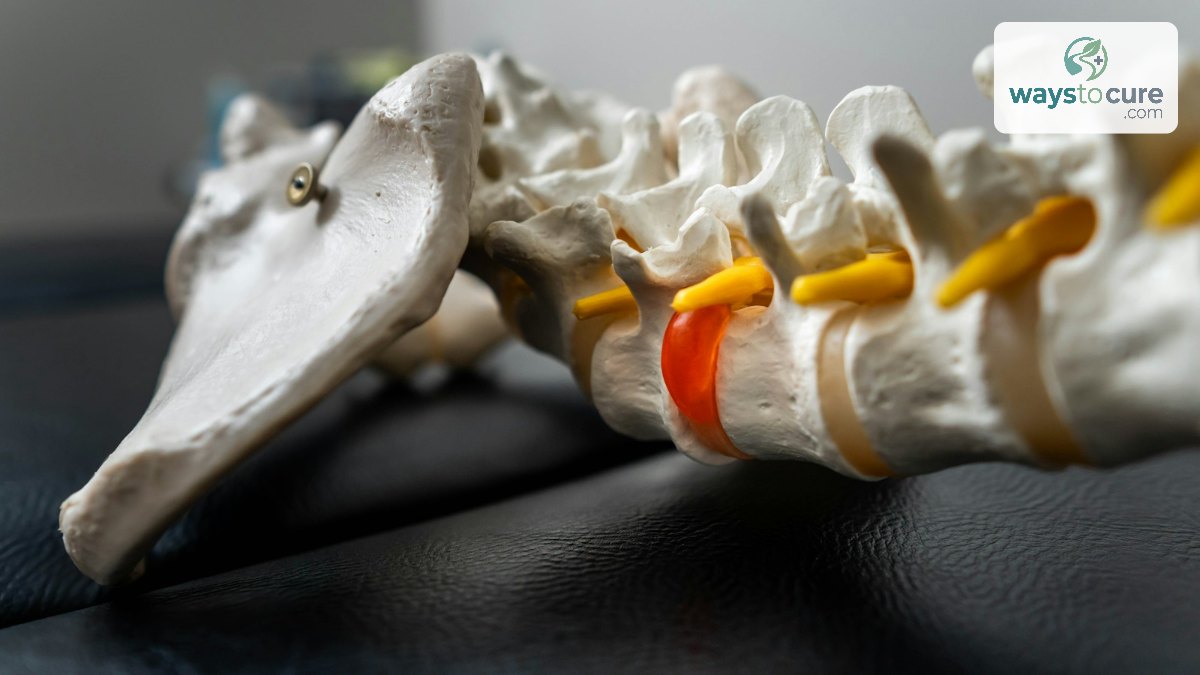
Between each pair of vertebrae sits a disc: a tough outer ring with a softer, gel-like centre. It works as a shock absorber. In a “slipped” disc, nothing slips out of place. As the NHS describes it, the soft cushion bulges outwards. Doctors call this a herniated or prolapsed disc.
A bulging disc doesn’t always cause pain. It hurts when it presses on or irritates a nearby nerve. That’s why two people with similar-looking discs on a scan can feel completely different.
Symptoms, including sciatica
A slipped disc can happen in the lower back or the neck, and the symptoms differ. According to Cleveland Clinic, common symptoms are:
- Lower back: back pain; sharp pain shooting from the buttock down the leg, sometimes into the foot (sciatica); tingling or numbness in the leg or foot; muscle weakness
- Neck: neck pain; pain between the shoulder blades; pain, numbness or tingling running into the shoulder, arm, hand or fingers
Sciatica is a description, not a separate disease. The NHS explains that it happens when the sciatic nerve, which runs from the lower back to the feet, is irritated or compressed. A herniated disc is one of the commonest reasons. Our article on the causes of sciatica covers the others. If your symptoms are mainly in the neck and arm, see also cervical spondylosis.
How long recovery takes
The natural course is reassuring for most people:
- Cleveland Clinic says herniated discs usually heal on their own within four to six weeks, and around 90% improve without surgery.
- The American Academy of Orthopaedic Surgeons (AAOS) says symptoms slowly improve over days to weeks, and most patients are free of symptoms by 3 to 4 months.
- The NHS says sciatica usually gets better in a few weeks to a few months, but can sometimes last longer.
Improvement is rarely a straight line. Good days followed by a bad day are normal, and a flare doesn’t mean you’ve done new damage.
Stay active, don’t stay in bed
For years people were told to lie flat for weeks. That advice has changed. A Cochrane review found small benefits in pain and function from advice to stay active compared with bed rest for acute low back pain, and little or no difference between the two for sciatica. In other words, lying in bed doesn’t speed recovery, and moving keeps you from stiffening up and losing strength.
In practice:
- If the pain is severe, a day or two of rest is fine. The AAOS advises against staying off your feet for longer than that.
- Carry on with your normal activities as much as you can. The NHS says movement, even when it’s painful, isn’t harmful.
- Start gentle exercise such as walking, swimming or yoga, as the NHS suggests. Any activity is fine as long as it doesn’t cause or worsen the pain.
- Break up long periods of sitting. The AAOS suggests taking regular breaks and avoiding long stretches in a chair. At a desk job, stand up and walk around between tasks.
- Avoid heavy lifting and twisting for now: carrying full water buckets, lifting a gas cylinder, or moving furniture can wait.
Good habits for later, once the pain settles, are covered in our guide to posture and spinal health.
Using heat and cold safely
Cleveland Clinic lists heat or ice as a home measure, and the NHS suggests heat packs for sciatica. Neither changes the disc, but both can ease muscle spasm and make it easier to move. Use whichever feels better.
Heat packs and hot water bottles can burn, especially microwaved packs. Consumer-safety guidance from New South Wales says:
- Don’t put a heat pack directly on bare skin. Wrap it in a towel.
- Follow the microwave heating time on the pack and never overheat it.
- Don’t use a heat pack as a bed warmer, and don’t fall asleep with one on.
- Never fill a hot water bottle with boiling water.
- Take extra care if you have diabetes, numbness or reduced feeling in the area, or are elderly, because you may not feel a burn developing.
The same goes for ice: wrap it in a cloth and keep sessions short. Numbness from a slipped disc can stop you noticing that the skin is getting damaged, so check the skin underneath every few minutes.
Painkillers and their limits
Painkillers make it easier to keep moving. They don’t heal the disc.
- Anti-inflammatories such as ibuprofen: the NHS slipped disc page says they may help, and suggests taking them regularly (within the daily limit) rather than only when pain is bad. For sciatica specifically, the NHS says it’s not clear how much they help.
- Paracetamol: the NHS says paracetamol is unlikely to help sciatica on its own.
- Codeine-based painkillers: should only be used for a few days, according to the NHS.
Check with a doctor or pharmacist before taking ibuprofen if you have a stomach ulcer (now or in the past), asthma, heart, liver or kidney disease, take blood thinners, or are pregnant. The NHS advises taking it with or after food. Avoid “pain relief” injections from unqualified practitioners and unlabelled mixtures; if pain is that bad, see a doctor.
Physiotherapy and exercise
MedlinePlus says physical therapy is important for nearly everyone with disc disease. A physiotherapist will show you how to move and lift without straining your back and give you exercises that strengthen the muscles supporting your spine. The AAOS describes targeted exercises for the lower back and abdomen as a standard part of non-surgical care.
Start with what the physio prescribes rather than copying intense workouts or deep forward bends from videos. If an exercise sends pain shooting further down your leg, stop it and tell your physio. For general back-pain self-care, see our article on ways to ease lower back pain.
When scans, injections or surgery come in
| Step | When it’s usually considered |
|---|---|
| MRI scan | The main test to confirm a herniated disc and see which nerve is affected (AAOS). A plain X-ray can’t diagnose a herniated disc on its own (MedlinePlus). |
| Stronger painkillers or a short course of muscle relaxant | When pain isn’t controlled by over-the-counter medicines (NHS). |
| Epidural steroid injection | For people who haven’t improved with other non-surgical care; the AAOS says there’s good evidence it relieves pain for many of them. |
| Surgery (usually microdiscectomy) | If symptoms don’t improve with other treatment, if weakness or numbness is getting worse, or as an emergency when nerves to the bladder or bowel are affected (NHS, AAOS, Cleveland Clinic). |
The NHS notes that surgery is not usually needed. If a surgeon recommends it, it’s reasonable to ask what happens if you wait, and what the expected recovery looks like.
Go to hospital now: cauda equina warning signs
Very rarely, a large disc presses on the bundle of nerves at the bottom of the spinal canal (the cauda equina). The AAOS calls loss of bladder or bowel control a medical emergency that needs immediate attention, and Cleveland Clinic notes that emergency surgery may be needed when a disc damages the nerves to the bladder or bowel. The NHS says to call for emergency help or go to the emergency department straight away if you have back pain with:
- numbness or loss of feeling around your genitals or bottom (the area you’d sit on a saddle)
- difficulty peeing, being unable to pee, or losing control of your bladder or bowels
- pain, tingling, weakness or numbness in both legs, or sciatica on both sides
- weakness or numbness in your legs that is severe or getting worse
- back pain that started after a serious accident, such as a road crash or fall
In India, call 112 or get someone to take you to a hospital emergency department. Don’t drive yourself, and don’t wait to see if it settles overnight.
When to see a doctor
Book an appointment (not an emergency) if:
- painkillers aren’t helping, or the pain hasn’t improved after a few weeks
- you’re no better after four to six weeks of home care
- you have tingling, numbness or weakness in one arm or leg, or trouble standing or walking
- pain is worse at night
- you have a fever or feel hot and shivery, unexplained weight loss, or swelling in your back
Frequently asked questions
Can a slipped disc heal on its own?
Often, yes. Cleveland Clinic says around 9 in 10 people improve without surgery, and the AAOS says most are symptom-free by 3 to 4 months.
Should I lie flat in bed until the pain goes?
No. A day or two of rest is fine if pain is severe, but research shows bed rest doesn’t help recovery more than staying active. Get moving gently as soon as you can.
Do I need an MRI straight away?
Not always. Your doctor will examine you first. An MRI is the main test to confirm a herniated disc and is used when the result would change your treatment. Any emergency warning signs need urgent assessment.
Can massage, oils or herbal remedies cure a slipped disc?
No. There’s no evidence that any oil, herb or massage “puts the disc back”. Some people find massage relaxing, but avoid forceful manipulation of the spine while you have nerve symptoms unless a doctor or physiotherapist has assessed you.
Is a belt or back brace helpful?
Ask your doctor or physiotherapist before buying one. The treatments with the best support are staying active and doing the exercises your physio gives you, so don’t use a belt as a substitute for moving.
This article is for general information and is not a substitute for advice from a doctor. If you have symptoms or a health condition, please consult a qualified healthcare professional.