Most people can come off omeprazole safely, either by lowering the dose step by step or by stopping and taking it only on days when symptoms flare. Expect some extra heartburn for the first few weeks, because your stomach briefly makes more acid than usual after a proton pump inhibitor (PPI) is stopped, and plan for that rather than reading it as proof you still need the pill.
The same approach works for other PPIs such as esomeprazole, pantoprazole, lansoprazole and rabeprazole.
Why stopping omeprazole can cause rebound acid
PPIs switch off most of the acid pumps in your stomach lining, and your body responds by building up its acid-making capacity. Stop the drug and, for a while, that extra capacity runs unchecked. Doctors call this rebound acid hypersecretion.
It isn’t just a theory. In a Danish trial published in Gastroenterology, 120 healthy volunteers with no reflux took either esomeprazole 40 mg a day for 8 weeks or a placebo. In the 4 weeks after the drug was swapped for a dummy pill, 44% of the PPI group reported at least one clear acid symptom (heartburn, regurgitation or indigestion), compared with 15% of the placebo group. About 1 in 5 in the PPI group were still getting symptoms 4 weeks after stopping.
So a bit of heartburn after stopping doesn’t automatically mean your original problem is back. It’s also how people who never really needed a PPI end up on one for years: every attempt to stop seems to “prove” they need it.
Who should not stop without talking to a specialist
For some conditions, a PPI is long-term treatment, not a crutch. Both the American Gastroenterological Association (AGA) 2022 expert review and the Canadian PPI deprescribing algorithm from deprescribing.org advise against routine stopping if you have:
- Barrett’s oesophagus (changed cells in the lower food pipe, often found on endoscopy)
- Severe erosive oesophagitis, an oesophageal ulcer, or a narrowing (stricture) of the food pipe
- A past bleeding stomach or duodenal ulcer
- A high risk of stomach bleeding, for example if you take NSAID painkillers such as ibuprofen or naproxen every day, especially alongside blood thinners or steroids
- Eosinophilic oesophagitis or idiopathic pulmonary fibrosis (both listed in the AGA advice)
In the UK, NICE guidance on reflux and dyspepsia says people who’ve had a stricture stretched should stay on full-dose PPI long term. Not sure why you were started on omeprazole? Find out before you change anything.
Who is usually a good candidate to stop
The Canadian algorithm recommends trying to reduce or stop a PPI in adults who have:
- Had heartburn or reflux (GERD) or mild to moderate oesophagitis treated for 4 to 8 weeks, and the symptoms are now controlled
- Finished 2 to 12 weeks of treatment for a stomach ulcer caused by NSAIDs or H. pylori
- Finished 2 weeks of H. pylori treatment and have no symptoms
- Been started on a PPI in hospital (for example, in intensive care) and never had it reviewed
- Been taking it for indigestion without an endoscopy and have had no symptoms for at least 3 days in a row
NICE goes further: anyone on long-term treatment for dyspepsia should have a yearly review and be encouraged to step down or stop, unless there’s a condition or another medicine that needs the PPI.
Taper or stop suddenly: what the guidelines say
There’s no single correct method. The AGA review says either a taper or stopping outright is reasonable, and the deprescribing.org algorithm notes there’s no evidence that one tapering approach beats another.
The two options it rates as equally strong:
- Lower the dose. Go from twice daily to once daily, halve the dose, or take it every second day. Evidence suggests this doesn’t raise the chance of symptoms coming back compared with staying on the higher dose.
- Stop and use “on demand”. Take your usual dose daily only when symptoms appear, and stop again once they’ve gone. About 1 in 10 people find symptoms return with this approach.
A third, weaker option is switching to a daily H2 blocker such as famotidine. With that route, about 1 in 5 people get symptoms back.
A sample omeprazole step-down plan
If you’ve been on omeprazole for months or years, a gradual taper often feels easier because it spreads the rebound out. The table below is an example to discuss with your doctor or pharmacist, not a fixed prescription. It uses the standard omeprazole dose of 20 mg and the low maintenance dose of 10 mg listed in the deprescribing.org algorithm.
| Stage | What you take | Suggested length | For occasional heartburn |
|---|---|---|---|
| Starting point | Omeprazole 20 mg twice a day | Current dose | Antacid or alginate |
| Step 1 | Omeprazole 20 mg once a day, before breakfast | 2 to 4 weeks | Antacid or alginate |
| Step 2 | Omeprazole 10 mg once a day, or 20 mg every second day | 2 to 4 weeks | Antacid or alginate |
| Step 3 | Stop daily use; take 20 mg only on days with symptoms | Ongoing | Antacid, alginate or an over-the-counter H2 blocker |
| Review | Check in with your doctor or pharmacist | At 4 and 12 weeks | Agree a plan if symptoms persist |
If you only take 20 mg once a day, start at Step 2. For other PPIs, the algorithm lists these standard and low doses: pantoprazole 40 mg and 20 mg, lansoprazole 30 mg and 15 mg, rabeprazole 20 mg and 10 mg, esomeprazole 20 to 40 mg and 20 mg.
How to get through the rebound weeks
Plan for the first 2 to 4 weeks to be the bumpiest. These steps help, and they come from the deprescribing.org algorithm and NICE:
- Keep a rescue medicine at home. An antacid (calcium carbonate, such as Tums or Rennie) or an alginate (such as Gaviscon) works within minutes for breakthrough heartburn. NICE specifically mentions returning to antacids or alginates as part of stepping down.
- Stop eating 2 to 3 hours before bed. A full stomach lying flat is the classic reflux setup. Our piece on late-night eating covers other reasons to move dinner earlier.
- Raise the head of your bed with blocks under the legs or a wedge, rather than piling up pillows, which bend you at the waist.
- Work out your own triggers. Common ones are large fatty meals, alcohol, coffee, chocolate, spicy food and fizzy drinks. If festive eating set things off recently, our acidity and bloating reset has simple meal ideas.
- Lose weight if you’re carrying extra round the middle, since it pushes stomach contents upward.
Long-term PPI risks: should they push you to stop?
Long-term use has been linked with some side effects. The US National Library of Medicine’s MedlinePlus omeprazole page says people on PPIs may be more likely to break a wrist, hip or spine bone, and may develop stomach polyps, with the highest risk in people on high doses or taking them for a year or more. The NHS omeprazole page notes that serious side effects such as very low vitamin B12 and weaker bones are more likely after a year or more. The deprescribing.org algorithm also lists C. difficile diarrhoea, pneumonia and low magnesium.
Still, the AGA review is clear that these possible harms shouldn’t be the reason you stop. The decision should rest on one question: do you still have a good reason to take the drug? If you have Barrett’s oesophagus, for instance, the benefit outweighs these risks. If you were put on omeprazole for a short bout of indigestion three years ago, the balance tips the other way.
What to do if symptoms come back
Some heartburn in the first few weeks is expected. The deprescribing.org algorithm suggests acting if symptoms last 3 to 7 days and get in the way of normal life. At that point, your doctor may:
- Test and treat you for H. pylori, a stomach infection that can keep symptoms going
- Put you back on your previous dose for now and try again later, perhaps with a slower taper
- Settle on the lowest dose that keeps you comfortable, which is still a win compared with a higher dose
Going back on a PPI isn’t a failure.
When to see a doctor
Don’t just push through these. See a doctor promptly if you have:
- Difficulty swallowing, or food that feels stuck
- Pain when you swallow
- Weight loss you can’t explain
- Repeated vomiting
- Heartburn that wakes you at night despite antacids, or that’s no better after the first month off the PPI
- Severe watery diarrhoea with stomach pain or fever that doesn’t settle (if you’re still taking or recently took a PPI)
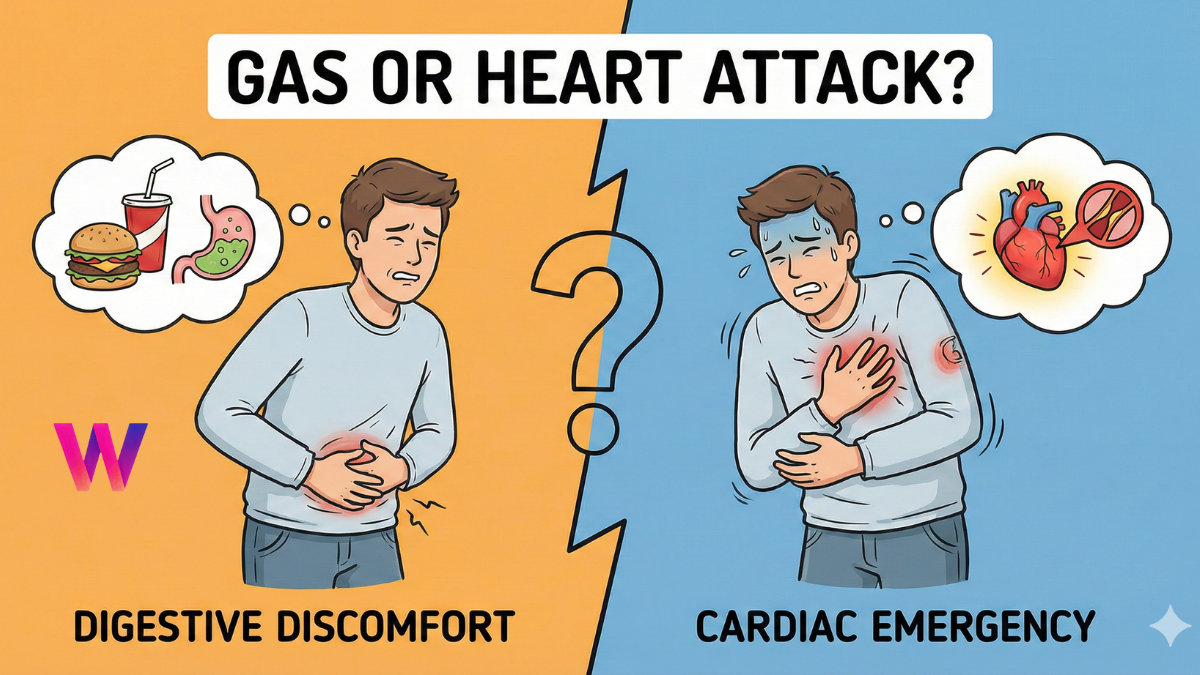
Get emergency help, calling your local emergency number (911 in the US, 999 in the UK, 112 in the EU and India), if you vomit blood or something that looks like coffee grounds, pass black, tarry stools, or have chest pain that spreads to your arm, neck, jaw or back, or comes with sweating or breathlessness. Chest pain is not something to blame on reflux by default. Our guide on telling gas pain from a heart attack explains the differences, but if in doubt, get checked.
Frequently asked questions
How long does rebound acid last after stopping omeprazole?
Usually a few weeks. In the trial of healthy volunteers, symptoms clustered in the first weeks after stopping, and about 1 in 5 still had some 4 weeks later. It tends to be mild to moderate.
Can I stop omeprazole cold turkey?
Many people can, and the AGA says it’s a reasonable option. If you’ve been on it a long time or at a high dose, a step-down taper may feel easier. Don’t stop on your own if you have Barrett’s oesophagus, severe oesophagitis or a past bleeding ulcer.
Is famotidine a good bridge off omeprazole?
It can be. Daily H2 blockers like famotidine are a recognised, though weaker, option. About 1 in 5 people get symptoms back on them. Taking famotidine only on bad days is another way to use it.
Does stopping omeprazole cause constipation or bloating?
Those aren’t typical rebound symptoms. If your bowel habits change, look at diet and fluids first; our guide to winter constipation has practical fixes. See a doctor if changes last more than a few weeks.
Can I buy omeprazole over the counter and keep taking it?
Over-the-counter packs are meant for short courses. MedlinePlus says the US non-prescription tablets are taken for 14 days, with repeat courses no more often than once every 4 months. If you need it more than that, see a doctor.
This article is for general information and is not a substitute for advice from a doctor. If you have symptoms or a health condition, please consult a qualified healthcare professional.