Some links in this guide are Amazon affiliate links. If you buy through them, Ways to Cure may earn a small commission at no extra cost to you. We haven’t been paid to include any product, and we haven’t tested these products ourselves; our picks are based on published standards, validation lists and manufacturer specifications.
For most homes, a simple fingertip pulse oximeter is all you need. The one thing that matters most is proof of accuracy: an FDA clearance or independent test results, not a “medical grade” sticker on the box.
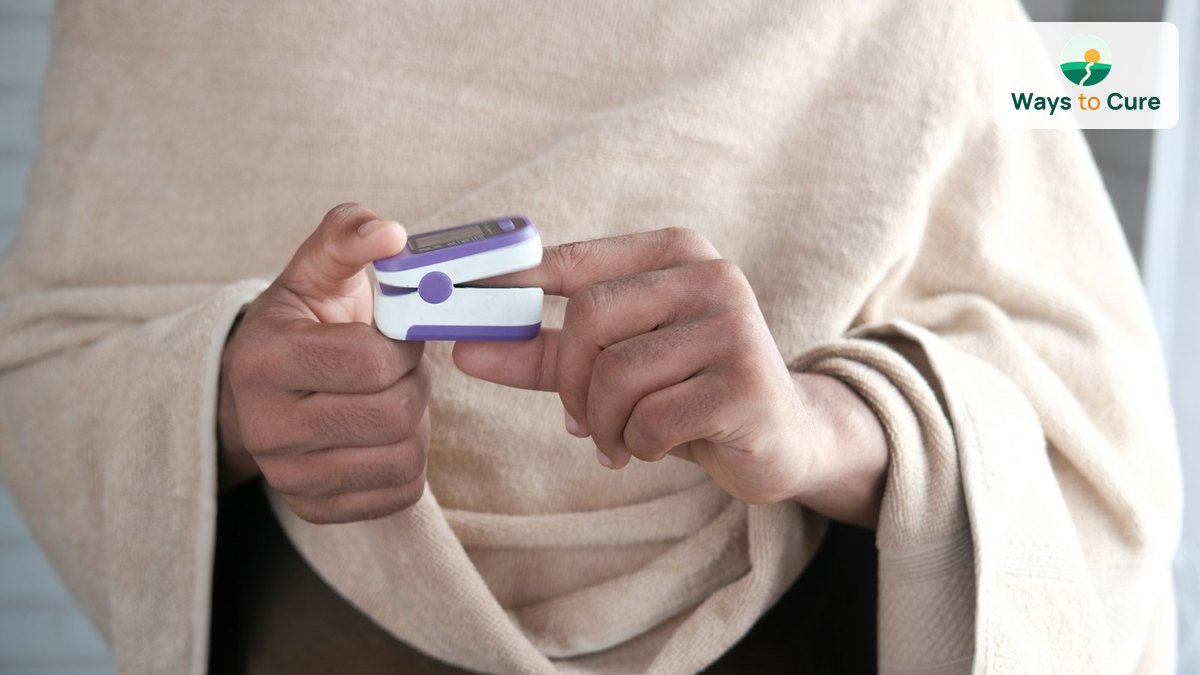
A pulse oximeter clips onto your finger and shines light through it to estimate how much oxygen your blood is carrying (SpO2) and your pulse rate. During flu and pneumonia season it can help you decide when a sick family member needs a doctor. But cheap devices vary a lot, and a reading that’s off by a few points can hide a real problem.
Who needs one (and who doesn’t)
A home oximeter is useful if:
- Your doctor has asked you to track oxygen levels, for example with COPD, asthma, heart failure or after a hospital stay.
- You’re caring for an older adult or someone with a chest infection at home. Our guide to early pneumonia signs in older adults explains why oxygen can drop before other symptoms look serious.
- Someone at home has a respiratory illness and you want an extra signal alongside symptoms.
You probably don’t need one if you’re healthy and have no lung or heart condition. Daily checks won’t make you healthier, and random dips cause needless worry.
What to look for
| Feature | Why it matters | What to avoid |
|---|---|---|
| FDA clearance (US) or independent accuracy data | The FDA notes that accuracy can be affected by poor circulation, skin pigmentation, skin temperature, tobacco use and nail polish. Cleared devices have been through clinical testing. | Boxes that say “medical grade” with no clearance number or test data behind it. |
| Accuracy across skin tones | In an independent study, most devices did worse in people with darker skin. This matters for many readers in India and the US. | Brands that won’t share any accuracy figure (often written as ARMS). |
| Clear, rotating display | You’ll read it at night, often on someone else’s hand. | Tiny dim screens you have to tilt to read. |
| Pleth wave or signal bar | Shows whether the reading is steady. A jumpy wave means the number isn’t reliable yet. | Devices that only flash a number. |
| AAA batteries and auto-off | Easy to replace anywhere, and the device won’t drain in a drawer. | Odd button cells you can’t buy locally. |
| Local warranty and service | You want someone to contact if it fails. | Unbranded imports with no importer or support details on the box. |
Types compared
Fingertip spot-check oximeters
The small clip-on units sold everywhere. Cheap, portable and right for most homes, but quality varies widely.
OTC FDA-cleared fingertip oximeters
A newer group in the US. These have FDA clearance for over-the-counter use, which means clinical accuracy testing. They cost more, but you know what you’re getting.
Wearables and smartwatches
Handy for trends during sleep or exercise, but most aren’t cleared as medical devices for SpO2. Don’t use them to decide whether someone needs care.
Options worth considering
We’ve only included models we could confirm through a regulator’s database, a peer-reviewed study or the manufacturer’s site. Models differ by country.
1. Nonin TruO2 OTC (Model 3250)
- Who it suits: US households that want a cleared device with an app for keeping a log.
- Where it’s sold: US.
- Why it’s here: Nonin’s product page says it has FDA clearance for over-the-counter use, connects by Bluetooth to the NoninConnect app, and gives up to 2,200 spot checks on two AAA batteries.
- Drawback: The 2-year warranty is shorter than some cheaper brands offer, and you pay extra for the app features.
Check Nonin TruO2 OTC on Amazon US
2. Masimo MightySat Medical
- Who it suits: US buyers who want an FDA-cleared OTC device from a maker of hospital monitors and don’t mind paying more.
- Where it’s sold: US.
- Why it’s here: The FDA’s device database (AccessGUDID) lists it as an over-the-counter pulse oximeter with 510(k) clearance K214115. A MightySat model also met the FDA accuracy threshold in the independent study described below.
- Drawback: It’s priced at the premium end. For occasional checks during a cold, a cheaper accurate device does the same job.
Check Masimo MightySat Medical on Amazon US
3. Nonin Onyx Vantage 9590
- Who it suits: Anyone with darker skin, or caregivers who want the strongest independent accuracy data.
- Where it’s sold: US. We couldn’t confirm an official India listing.
- Why it’s here: In a 2024 study of 11 fingertip oximeters in EBioMedicine, it had the lowest overall error (ARMS 2.0%) of the devices tested. Nonin’s product page lists up to 6,000 spot checks on two AAA batteries and a 4-year warranty.
- Drawback: It’s mainly sold for clinics, so it’s pricier and plainer than consumer models, with no app.
Check Nonin Onyx Vantage 9590 on Amazon US
4. Zacurate Pro Series 500DL
- Who it suits: US buyers on a tight budget who want something that’s at least been independently checked.
- Where it’s sold: US.
- Why it’s here: In the same independent study, the Zacurate CMS 500DL met the FDA’s 3% accuracy threshold (ARMS 2.5%), which is better than some FDA-cleared devices managed.
- Drawback: The FDA database lists it under “sporting, aviation” oximeters, so it isn’t cleared for medical use. Fine for home checks, but don’t treat it as a clinical device.
Check Zacurate 500DL on Amazon US
5. Omron Pulse Oximeter CMS50D4
- Who it suits: Indian families who want a known brand with local support.
- Where it’s sold: India.
- Why it’s here: It’s listed on Omron Healthcare India’s site with a 0.96-inch colour display showing SpO2, pulse rate and a bar graph, adjustable brightness and automatic standby, plus warranty registration.
- Drawback: Omron doesn’t publish an accuracy figure for it, so you’re relying on the brand rather than test data.
Check Omron CMS50D4 on Amazon India
6. Beurer PO 35
- Who it suits: Older users in India who struggle with small screens.
- Where it’s sold: India and Europe. The Irish device register Medaval lists India among its markets.
- Why it’s here: Beurer’s product page lists a colour display that turns automatically to face you, a pulse bar or wave, auto switch-off, two AAA batteries and a 5-year guarantee.
- Drawback: Medaval found no peer-reviewed accuracy validation for it. Treat readings as a guide and confirm worrying numbers.
Check Beurer PO 35 on Amazon India
Is a cheaper one good enough? Often, yes. In that study, the budget Zacurate 500DL did about as well as several cleared devices. What matters is evidence, not price. In India, where independent data is scarce, buy a known brand with a local warranty.
How to use it correctly
This routine is adapted from an NHS pulse oximeter guide:
- Take off nail polish or false nails, and warm your hands if they’re cold.
- Sit and rest for at least 5 minutes.
- Rest your hand on your chest with your fingers relaxed.
- Push your fingertip all the way in so the nail is covered. Try another finger if there’s no reading after 30 seconds.
- Keep it on for at least a minute so the number settles, then note it. If it keeps bouncing, take the middle value.
- Write down the time, reading and how the person feels. A trend tells a doctor far more than one number.
Common buying mistakes
- Trusting “medical grade” or “clinically accurate” labels. Look for a clearance number or published test data instead.
- Buying the cheapest unbranded unit. In the independent study, 5 of 11 devices missed the FDA accuracy threshold.
- Using a smartwatch for a sick person. It’s not designed for that decision.
- Ignoring skin tone. If anyone in your home has darker skin, favour a device with published results across skin tones.
- Buying a child’s oximeter in an adult size. Adult clips often don’t fit small fingers well, which gives poor readings.
When to see a doctor instead of relying on the device
The FDA’s advice on pulse oximeters is simple: don’t rely only on the reading, and contact a health care provider if symptoms are serious or getting worse. Use symptoms first and the number second.
- Call your local emergency number (911 in the US, 112 in India) for severe breathlessness, blue or grey lips, confusion, chest pain or trouble staying awake, whatever the oximeter says.
- In the NHS guide above, a reading of 92% or lower more than once within an hour is an emergency, and 93 to 94% means you should get urgent medical advice the same day.
- If you have COPD or another lung condition, your normal level may be lower. Ask your doctor for your own target. Our explainer on spirometry results for COPD covers how lung function is actually measured.
- For children, watch for fast breathing and chest indrawing. See our list of pneumonia danger signs in children under 5.
Frequently asked questions
What’s a normal oxygen level?
For most healthy adults, 95% or above is reassuring. The NHS guide treats 95% and up with a pulse of 50 to 90 beats per minute as a good reading. People with long-term lung disease may have a different target set by their doctor.
Do pulse oximeters work on darker skin?
Less reliably, on average. The FDA lists skin pigmentation as a factor that can affect accuracy, and in the 2024 study most devices trended worse in people with the darkest skin. The risk is a reading that looks fine when oxygen is actually lower, so lean on symptoms too.
Can I use a pulse oximeter for COVID or flu at home?
Yes, as one tool alongside symptoms. It can show a downward trend during illnesses like walking pneumonia or flu. It can’t diagnose an infection or tell you which one you have.
Is a more expensive oximeter more accurate?
Not always. Several low-cost devices met the FDA threshold in independent testing, and some FDA-cleared ones didn’t. Look for evidence, then pick the cheapest model that has it.
How often should I check?
Only when someone is unwell or your doctor asks. During an illness, twice a day plus whenever the person feels worse is a reasonable routine to agree with your doctor. Checking constantly when you’re well isn’t helpful.
If you’re building a home health kit, our home blood pressure monitor buying guide uses the same evidence-first approach.
This article is for general information and is not a substitute for advice from a doctor. If you have symptoms or a health condition, please consult a qualified healthcare professional.